UNEP - UNITED NATIONS ENVIRONMENT PROGRAMMME
GEF - GLOBAL ENVIRONMENT FACILITY
TERMINAL EVALUATION REPORT
OF GEF PROJECT NO GF/1100-99-14
"INTEGRATED MANAGEMENT OF LAND-BASED ACTIVITIES IN
THE SÃO FRANCISCO RIVER BASIN"
Carlos E. M. Tucci
- i -
June 2005
CONTENTS
1. INTRODUCTION................................................................................................................1
1.1. Project Background .......................................................................................................1
1.2. Scope of this Evaluation ................................................................................................1
2. REGIONAL BACKGROUND.............................................................................................1
2.1. Brazil Water Resource Development.............................................................................1
2.2. The São Francisco Basin ...............................................................................................4
2.2.1. Main Features of the River Basin............................................................................4
2.2.2. Institutional Development.......................................................................................4
3. SCOPE, OBJECTIVE AND EVALUATION .....................................................................5
3.1. Project Objectives and UNEP Mandate .........................................................................5
3.2. Project Components.......................................................................................................7
3.2.1. Diagnostic Analysis of the Basin ............................................................................7
3.2.2. Strategic Action Programme...................................................................................8
3.3. Evaluations ....................................................................................................................9
3.3.1 Methodology............................................................................................................9
3.4. Project Performance ......................................................................................................9
3.4.2. Overall Evaluation and Evaluation of Sub-Projects ................................................9
3.4.1. Project Management .................................................................................................11
3.4.2. Achievements .......................................................................................................12
3.4.3. Stakeholder Involvement ......................................................................................15
3.4.4. Sustainability ........................................................................................................15
3.4.5. Scope, Quality and Significance of Project Outputs .............................................16
4. FINDINGS AND CONCLUSIONS ...................................................................................18
4.1. Environmental Assessment..........................................................................................18
4.2. Water Resource Management ......................................................................................19
4.3. Institutional Arrangements ..........................................................................................19
4.4. Conclusions .................................................................................................................19
5. LESSONS LEARNED AND RECOMMENDATIONS.....................................................20
6. OVERALL CONCLUSIONS AND RECOMMENDATIONS ..........................................21
7. REFERENCES AND BIBLIOGRAPHY ..........................................................................23
- ii -
ANNEX A - EVALUATION OF SUB-PROJECTS
..........................................................27
ANNEX B - SFRB BASIN COMMITTEE ...................................................................39
ANNEX C COFINANCING
ANNEX D TERMS OF REFERENCE FOR THE EVALUATION
- iii -
EXECUTIVE SUMMARY
BACKGROUND
Project: The Ministry of Environment of Brazil requested the United Nations Environment
Programme (UNEP) to arrange for GEF (Global Environment Facility) support for the preparation of a
water resources management programme for the São Francisco River Basin. A project proposal for
improving water resources management in the basin was prepared and, in July 1999, the GEF
approved grant funds to conduct planning and feasibility studies required to formulate a Water
Management Programme that will promote environmentally sustainable development of the basin as a
means of reducing environmental degradation of the coastal zone. This project has been under
implementation since September 1999 with the Organization of American States (OAS) as the
Executing Agency. At the national level, the Brazilian Secretariat of Water Resources (SRH
Secretaria de Recursos Hídricos) was the executing agency up to 2000 when, following government
reorganization, the National Water Agency (ANA Agência Nacional de Águas) assumed national
responsibility for the project.
Water Resource Development in Brazil: The Water Resources Law (Law 9433/97) was approved in
1997 following lengthy negotiations among the sectors involved. This legislation created a national
policy for water resources management. The law establishes a framework for the basin committees to
regulate water rights and water charges.
Later, a second reform was adopted, leading to the creation of agencies for the control of
sectoral development, within which the ministries had defined policies and responsibilities. ANA was
created in July 2000 by Law 9984 and its mandate includes implementation of the Water Resources
Law 9433/97.
It can be said that the construction of the first phase of institutional development of Brazil's
water resources has been concluded. Legal elements have been established at the federal level for
water resources management and institutions for governance have been set up. At the State level,
almost all States have passed legislation. In this period, committees and agencies for Federal and State
basins were also established with varying degrees of success.
The implementation phase has progressed on a variety of fronts and one of the main
developments was the Implementation and development of management instruments that included the
establishment of basin committees and agencies with resources provided by charges for water use.
The São Francisco River is the third largest river in Brazil with a length of 2,700 km. The São
Francisco River Basin (SFRB) covers an area of about 640,000 km2 representing nearly 8 % of the
Brazilian National Territory. The river headwaters are located in the state of Minas Gerais and it also
drains areas of the States of Goias, Bahia, Pernambuco, Alagoas, Sergipe and part of the Federal
District. This includes areas of 503 counties with a total population of about 15 million inhabitants
most of them concentrated in the upper watershed.
Along its path, the river drains a diverse area, climatically, physically and in terms of
environmental and social diversity. Accordingly, the watershed is usually divided into 5 regions:
Upper; Middle; Lower Middle; Lower Sub-Basins; and Estuary and near Coastal Areas. The main
water and environment issues of these SFRB regions are:
Upper basin: Urban development impacts include floods, urban drainage and sewer effluents, heavy
metal releases from untreated industries and processing mill discharges; natural vegetation removal
for agriculture; soil erosion; and hydropower impacts on the natural environment.
Middle basin: High water demand due to irrigated agriculture; agriculture impacts due to the use of
pesticides from irrigated perimeters; shortage of water outside of the main river; sediments
transported to the river (causing sedimentation and silting of the river channel).
- iv -
Lower Middle: Sediments trapped in the reservoir; evaporation corresponds to about 20% of the mean
flow; shortage of water outside of the main river during most seasons; strong rainfall variability from
year to year and high impact on basin flow yield.
Lower and Coastal: Sediment transport has been reduced from 6 to 0.4 million tonnes/year. Clear
water and reduced channel depth have caused the proliferation of toxic algae affecting river biota.
The absence of floods due to reservoir regulation has reduced the access of fish to the marginal or
riparian lagoons for hatching. The number of families that depended on fishing has been reduced
from 38,000 to 20,000 in recent years. Coastal erosion has been caused by the reduced supply of river
sediment to the mouth of São Francisco River.
SCOPE, OBJECTIVES AND EVALUATION
Objectives and UNEP Mandate: The objective of this GEF-GPA demonstration project is to assist
the Government of Brazil to promote sustainable development of the SFRB and its coastal zone based
upon the implementation of an integrated approach to management of the watershed and the coastal
zone.
The GEF São Francisco project meets the objectives of GEF Operational Program #10 on
International Waters Land-based Activities Demonstration Project component. The project identifies
specific strategies, investment projects and activities that meet GEF criteria, catalyzes preparation of
an integrated Watershed Management Program (WMP) and serves as a demonstration project for the
implementation of the Global Programme of Action (GPA) for the Protection of the Marine
Environment from Land-based Activities in Latin America.
The anticipated results of the project were: (a) Improved river basin and coastal zone
environmental understanding among the public and scientific awareness and knowledge of the basin
and its coastal zone; (b) Improved public and stakeholder participation through hands-on involvement
of communities in remedial measures; (c) Improved organizational structure and staffing capacity
essential for implementing financial mechanisms for water rights and water charges as provided for
under Federal Law 9433/97; (d) Improved quantification of water use, hydrological management and
reduced use conflicts and; (e) Improved integrated management and environmentally sustainable
development of the SFRB.
Project components: The project was developed through the Diagnostic Analysis of the Basin (DAB)
of which the main components were specified in the project document. This leads to the formulation
of a Strategic Action Plan (PAE) (equivalent to a Strategic Action Programme or SAP).
The DAB was prepared based on the execution of 28 sub-projects. These projects were selected
in the PDF Phase through a number of seminars in different areas of the basin. The projects were
organized into four components: I - Environmental Assessment of the Basin and its Coastal Zone; II -
Public participation and stakeholder consultations: III - Development of the structural organization; IV
- Formulation of the Strategic Action Programme.
The SAP Strategic Action Programme has two components: Implementation of the Integrated
system of Water Resources Management of the basin and coastal zone, sustainable use of water
resources and environmental rehabilitation of the basin and its coastal zone.
Methodology of evaluation: Each sub-project was evaluated to determine its success on a scale from
1 to 5, with 1 being the highest (most successful) rating and 5 being the lowest. In rating the projects,
the following criteria were considered: Timeliness: how the project met the schedule and
implementation timetable cited in the project document and later revisions thereof; Achievement of
results/objectives (the extent to which the project's environmental and development objectives were
achieved); Attainment of outputs; Completion of activities; Project executed within budget; Impact
created by the project; Sustainability; Stakeholder participation/Public Involvement; Monitoring &
Evaluation. The evaluation was developed based upon the documents, interviews developed by
visiting the area and agencies and my knowledge of the basin and issues.
Results of the evaluation: The overall rating awarded was "Excellent" with an achievement rating of
90 100%. The highest ratings ("Excellent" 90 -100%) were related to attainment of outputs,
- v -
completion of the activities, impacts created by the project, public participation and monitoring. The
timeliness of project development, budget and sustainability were rated as being "very good" (75-
89%).
FINDINGS AND CONCLUSIONS
The findings were subdivided into three major components: environmental assessment, water
resources management and institutional arrangements.
Environmental assessment:
(1) The overall belief was that there was a process of desertification in Cabrobó semi arid region of
Pernambuco in the Lower Middle region of the São Francisco. Subsequent study showed this not
to be true (Project 2.1).
(2) One of the major issues mentioned by some professionals and members of the population was that
the saline intrusion of the São Francisco increased following dam construction upstream. Project
studies showed this to be untrue. In fact, the dams decreased the extension of the influence of the
saline intrusion (Projects 1.1a and 1.1b).
(3) The knowledge developed about sedimentation and erosion processes, nutrient loads and
mitigation practices for the recovery of the icthiofauna of Lower São Francisco were important
findings for the region.
(4) Evaluation of mining impacts on the water resources in the Velhas River near the Metropolitan
Region of Belo Horizonte has provided valuable support for discussions and decisions related to
the control of such impacts in Upper River Basin.
(5) The development of a water quality index, training of the population and creating a cadre of
volunteers in evaluating the water quality of the rivers are important successes.
(6) The evaluation of Basin Land Use, its change with time, sediment yield evaluation and bed
modification together with the dams and hydrologic behavior allow an understanding of the
impacts in the lower river and coastal zone. The reduction of sediment transport is due to the
combination of hydrologic conditions (low floods in a sequence of years) and effects of the
reservoirs that reduced the sediment in the lower reaches to a value of about 10% of that of
former years. This has resulted in a decreased supply of nutrients, increased coastal erosion and
decreased river turbidity, which allows the proliferation of macrophytes in the river.
(7) The practice of recovering natural vegetation mainly near the rivers has been developed
successfully in a pilot project, in cooperation with NGOs, with concrete results (Project 2.2b).
This activity represents important experience with public participation that can be transferred
and replicated.
Water Resource Management:
(8) The contribution of navigation to the development of agricultural competitiveness will support
governance decisions.
(9) The use of models to evaluate the basin behavior taking into account the hydropower and other
water uses is an important experience in the synergic integrated environment assessment which
can be used in other basins.
(10) The impact of water use in agriculture was evaluated together with its efficiency and the value
of the water in terms of the production and export of goods. This chain of economic value is an
important input into decisions regarding basin development.
(11) Water resource management plan developed under a pilot project (Project 3.3b) was an
important product for the future development of SFRB management plan.
Institutional Arrangements:
(12) Substantial public participation (~12,500 persons) in the projects and in the development of the
Strategic Action Plan has been important to validating decision-making processes in the basin.
- vi -
(13) Capacity building at different levels has been one of the major assets of the project in the areas
of: (a) soil conservation; (b) water quality evaluation; (c) understanding of environmental and
water resources issues and sustainability; and (d) public participation in committees.
(13) Development of a proposal for updating the hydrologic system network is a relevant aspect that
requires special attention in basin development since, without reliable information, it would be
impossible to develop a sustainable management regime.
(14) The establishement of the São Francisco River Basin committee and its consolidation during
recent years has been a most important output from this project. The development of any public
participatory process is both complex and lengthy involving the building of trust among the
people and resolving conflicts of interest. The following steps are the consolidation of the
interactions among the sub-basins, the establishment of regional committees and implementation
of the basin agency and the social and economic sustainability.
Conclusions:
Overall, the project has been successful with many achievements related to environmental assessment,
water management and institutional capacity. Some of the main conclusions are as follows.
· The development of a project document addressing most of the main issues in the basin. It is
very well orientated document that has provided a firm basis for successful development of
the project. It should, however, be noted that one important issue was not fully included,
namely human sustainability in semi-arid areas outside of the main river of SFRB water
supply influence in the sub-basins. In this region, water is the basis of life in economic, social
and environmental terms. The population of these sub-basins is very poor mainly because of
the lack of water. The reduction of poverty has a direct link to the improvement of
environmental conditions.
· Project management by the leading agencies was conducted very well with good standards in
report preparation, review of products, development of collaboration among researchers and
technical professionals in the various sub-projects and the preparation comprehensive
documents, folders, videos and other media for public information purposes.
· The project has led to some very important outcomes and impacts on the basin community,
federal institutions such as ANA, SRH, State administrations and the public including the
following: (a) increased collaboration and integration among research groups working in the
basin on similar or interrelated issues; (b) promoted strong interactions among stakeholders in
the basin committee allowing improved decision-making that has been extended to State
administrations in the Basin; (c) improved the coordination of investment of national, state
and international funds; and (d) raised awareness of the population on the issues and
mitigation measures and encouraged its participation in decision-making processes at all
levels.
· Continued support for this project is very important in order to build on the results achieved in
this project. The results obtained so far would not be lost if this project would come to and end
at this stage, however, such a stoppage would slow down the achievement of the long-term
planned goals.
LESSONS LEARNED AND RECOMMENDATIONS
The lessons learned through the implementation of the project relate to project management,
environmental assessment, water resources management and sustainability. Some of the most
important are the following:
· In the development of this type of project, it is important to promote integration of sub-
projects through workshops, specific visits or meetings among a few projects having common
interests and experience as well as promoting the use of common equipment and laboratories.
- vii -
· It is important that, beyond meeting project objectives, the development of sub-projects
creates synergy with other projects or sources of funding in order to enhance the sustainability
of institutions and research groups.
· The inter-relationships among climatic variability, dam operational conditions and soil use in
a basin are a complex non-linear combination that can lead the ecosystem to different levels of
stress. By understanding such processes, this knowledge can be used inter alia to formulate
terms of reference for impact assessments of reservoir for hydropower development, multiple
water uses of the system and to improve the characterization of processes through modeling.
· Learning how to enhance public participation in the assessment process and mitigation
measures on a voluntary basis was an important achievement and constitutes a lesson that can
be disseminated. Participation was developed in the basin committee through capacity
building in schools and raising public-awareness on the environmental issues related to its
local neighborhoods in rural and city areas.
· The São Francisco River is a large basin in a federal country with many states. The federal
legislation (water law and constitution) together with the State legislation has been the basis
for institutional arrangements. However, these legal instruments do not explicitly address how
to develop the institutional decentralization of basin management through basin committees
and agencies. The experience developed in the SFRB project is singular in this respect (see
main aspects in annex B) and provides experience for other countries to construct similar
mechanisms. Institutional arrangements are always unique due to the combination of legal,
social and economical circumstances but the successes and failures of the Brazilian
development process constitute a major asset of experience for development of similar
arrangements elsewhere.
· The DAB showed the importance of, and the needs for, integrated environmental impact
assessment in large basins and how synergistic interactions between the system and climate
variability can affect both the environment and the population
· The public participation processes for the development a Strategic Action Programme was a
very good example of decentralization and stakeholder participation in the preparation of a
plan. The participation was developed in the following ways: (a) participation of organizations
in the basin committee (b) in the committee of the sub-basin - (c) workshops convened in
different cities of the region - (d) in the State basin committee integrated to the Federal Basin.
OVERALL CONCLUSIONS AND RECOMMENDATIONS
Some of main conclusions and recommendations related to the framework of activities are:
· The investments of this project have already improved research and institutional capacity that
can make an important difference in the basin development. The project showed that these funds
were an important first step in the development of integrated water resource and land
management and has engendered enhanced technical and research capacities.
· The GEF project was the main instrument in the institutional development of the WMP. It was
not only important for the purposes of water management but also for environment protection in
the basin.
· The future sustainability of basin water resources development depends on government
investment in future phases of the PPA and the GEF project. The PPA investments are more in
the direction of human needs and efficiency in water development but with important
consequences for the environment, such as increased treatment of municipal wastes and
increased efficiency in water use.
· Due to the financial situation and structure of the governments, major portions of the funding in
the budget depend on the approval of the Minister of Economy. The PPA funds and ANA
budget will have limits with regards to the development of basin activities. Because the basin
region is one of the poorest in the country and one of the main government policies is to increase
- viii -
investment to improve social indicators, it is likely that funds related to social investments
(such as water supply and sanitation) will have less restrictions.
· ANA has been the institution within which the project has successfully developed. This is a new
institution created in 2000. Its directors have a mandate approved by the senate that is not
synchronous with political terms. The director who has been in charge during this phase of the
project was appointed by the former president Fernando Henrique and his relationship with the
government has improved with time. The president of ANA was subsequently appointed as
president of another Agency, the "Agência Nacional de Energia Elétrica" (ANEEL) (National
Electrical Energy Agency). The new government appointed the new president and a new
director of ANA at the beginning of 2005. They are both supporting the continuance of technical
and institutional developments that have taken place during the last four years.
· It is recommended that in the future development of the program the human water sustainability
in the semi arid sub-basin could be addressed by the project.
- ix -
1. INTRODUCTION
1.1. Project Background
In 1996, the Secretariat of Water Resources under the Ministry of Environment of Brazil, requested
the United Nations Environment Programme (UNEP) to submit a request for GEF (Global
Environment Facility) support for the preparation of a water resources management program (WMP)
for the São Francisco River Basin. Initial funds provided by the GEF through a PDF Block B Grant
(US$ 341,000) helped prepare a project proposal for improving water resources management in the
basin. In July 1999, the GEF approved grant funds to the value of US $ 4,430,000 to conduct planning
and feasibility studies required to formulate a WMP to promote environmentally sustainable
development of the basin as a means of managing and reducing environmental degradation of the
coastal zone. This project has been under implementation since September 1999 and was originally
scheduled to end in April 2003. The Organization of American States (OAS) has been designated as
the executing agency for the project. Since its formation in December 2000, ANA (the Brazilian Water
Agency under the Ministry of Environment) has taken over, from the Secretariat of Water Resources,
the responsibility for the national coordination of the execution of the project.
In accordance with UNEP/GEF policy, all UNEP GEF projects are subject to mid-term and
terminal evaluations by external evaluators contracted by UNEP. A Mid-term Evaluation of this
project was undertaken during the period 25 November 2002 to 17 January 2003 and the report was
presented in March 2004.
This report is a Terminal Evaluation of the project based on a review of the documents,
discussion with the lead consultant, who is responsible for preparing a consolidated overview of 5
GEF International Waters projects in Latin America, as well as field inspections and discussions with
community leaders and sub-project participants.
1.2. Scope of this Evaluation
Terminal evaluations specifically assess the main outputs, outcomes, findings, key lessons and best
practices of a GEF project. The results are used to benefit the design and implementation of future
projects in the country and the region as well as providing insights to the implementing and executing
agencies and the GEF.
The scope of this evaluation covered all key activities undertaken in the framework of the GEF
São Francisco project. It compares planned outputs of the project to actual outputs and evaluates the
actual results to determine their contribution to the attainment of project objectives.
The evaluation highlights lessons learned and best practices thus far from the implementation of
the project that would improve the future work in the basin and assesses the appropriateness of this
project in meeting the long-term objectives of the GEF. In this regard, the evaluation assesses the
extent to which: (i) sources of environmental stress in the basin have been adequately addressed
through project activities; (ii) mechanisms for joint management of the basin have been put in place or
strengthened through execution of the project; and (iii) there has been a change in environmental state
as a consequence of the project intervention.
The following chapter presents the country and regional background of the project. In Brazil,
water resource development is the base for regional development. Basin issues related to water use and
environment and the institutional development of the basin are subject to national decentralization
through the creation of basin committees and the National Water Agency. Chapter three presents the
main aspects of the project and an evaluation of sub-projects and outputs. Subsequent chapters discuss
the findings, lessons learned and recommendations.
2. REGIONAL BACKGROUND
2.1. Brazil Water Resource Development
Up until the 1980s, Brazil was a country in which water resource management was conducted sector
by sector without any integration. The active sectors were: energy (the sector best organized in respect
- 1 -
to sectoral planning); irrigation (during this period, the country even had a Ministry for Irrigation to
develop water use for irrigation purposes, principally in the North-East); the environment (with the
passing of environmental legislation (1981) and the creation of State agencies for control); water
supply and sanitation (represented by water and sanitation companies); and navigation (a more
marginal sector within the Ministry of Transport). Matters such as flooding and water-borne disease
were dispersed within the government structure but without receiving much priority.
In terms of institutional structure, only the water code approved in 1934 existed and projects
were approved by sectoral organs. The hydrological database was part of the Ministry for Mines and
Energy and projects were developed with a single objective, without any basin-wide vision being
adopted by sectoral entities, and with limited attention to the environment. The only planning was
undertaken by the hydroelectric sector that adopted the following steps for each undertaking:
assessment of hydroelectric potential, inventory of the entire basin and feasibility analysis, followed
by basic project design and execution of each hydropower initiative.
In the water and sanitation sector, State companies significantly extended water supplies but
paid little attention to the collection and treatment of sanitary waste, whilst urban drainage and solid
waste were of no account, despite frequent urban floods.
In the second half of the 1980s, principally after restrictions were imposed on hydropower
development by the international funding agencies and the beginning of funding for environmental
control in cities and biomes (e.g. the Amazon and the Pantanal), there was increased discussion about
the need for integrated water resource management within the country. The process was mainly
discussed within the Brazilian Association for Water Resources (Associação Brasileira de Recursos
Hídricos: ABRH) in technical terms and without party political components that might have impeded
its evolution and consolidation. The ABRH created a forum for discussion at various events and set
out the elements for consensus in its letters from Salvador in 1987 (multiple uses, decentralization,
national system for water resource management, improved legislation, development of technology and
human resources, information systems and national policy for water resources) and from Foz de
Iguaçu in 1989 (national policy for water resources, national management system, legislation,
technology and human resources and information systems: ABRH,1995). All the principles approved
in Dublin, on which Agenda 21 is based, were present in these documents.
In 1990, the sector managed to pass legislation that came to be the basis for sectoral funding in
spite of it serving the interests of States and townships more fully. The law concerning financial
compensation for flooding of productive agricultural land withheld 6% of the value of energy
produced by an installation to compensate the State and townships. However, a part of this resource
was earmarked for hydrological data collection, science and technology, and hydrological studies.
Nevertheless, the destination of these resources is the energy sector, which guarantees the creation and
maintenance of a hydrological database in permanent form. This was the first great success because,
independent of budgeting, resources are guaranteed by law for the collection of data and basic studies.
In this same period, some sectors had more weight than others in negotiations over legislation
the key players were:- the energy sector, which through its organization and resources, always
dominated water resource development; the environment sector, which countered with its assessment
of potential impacts and wished to participate in management processes; irrigation, because of the
circumstances at the time that resulted in the creation of a dedicated ministry on this topic. The water
supply and sanitation sector was less influential and was distanced from the process, principally
because it acted more at a state level while the focus of discussion was at the federal level.
With the reforms in the decade of the 1990s, a Secretariat for Water Resources (Secretaria de
Recursos Hídricos: SRH) was created in 1995. Working together with Congress, it became possible to
draw up a law that contained the principal technical elements of previous discussions, although some
points of discussion remained outstanding. In 1997, the Law on Water Resources was finally approved
after lengthy negotiation among the sectors involved (Law 9433/97). This legislation created a
National Policy in Water Resources. The law establishes the framework for the implementing basin
committees to regulate water rights and water charges.
- 2 -
Within government, a second reform was drafted, leading to the creation of agencies for the
control of sectoral development once the ministries had defined their policies. The National Water
Agency (Agência Nacional das Águas: ANA) was created at this time of politico-institutional
governance in July of 2000 by Law 9984. Its mandate includes implementing the Water Resources
Law 9433/97.
With the creation of this agency, the law concerning compensation for flooded land by dams
was changed to provide funds for the water management sector. The levy on the industry being 6.75%
of the value of energy generated and ANA receives 11.1% of the total levy. Science and Technology
applied to water resources received 3.67 % of the compensation funds. These are considerable sums
for a sector that, until the passing of legislation, had been funded by budget leftovers.
It can be noted that the first phase (here termed Phase I) of the institutional development of
Brazil's water resources has now been concluded. In it, legal elements have been established at federal
level for management and institutions for governance have been established. At state level, almost all
States have passed legislation and some have set up agencies for development, although at present
these are few in number (Tucci, 2003).
In this period, committees and agencies for Federal and State basins were also set up, with
varying degrees of success. Most basins have just a committee, which has limited activity. In the
sector of Science and Technology, there has been considerably increased investment in research that
focuses on problems and is provided with continuing resources.
The subsequent phase has developed (here called Phase II) on various fronts. These are outlined as
follows (Tucci, 2003).
Sectoral Legislation: Legislation and the management of water resources must be considered together
but the sectors still need elements that allow socio-economic development and promote sustainable
environments. Principally, water supply and sanitation sectors, together with the energy sector, are
developing the legal basis needed to ensure sustainability of development. This is the present phase of
legal construction that provides compatibility between the objectives of water resources law and
sectoral development. Various problems have been identified and actions are being taken in the search
for this legal framework and for the construction of an integrated basis for the management of water
resources.
Implementation and Development of Management Instruments: Establishment of basin
committees and agencies with resources given by charging for water use. For this development to
happen it is necessary for the three elements to exist (as described below); if they do not, success is
difficult.
National Plan for Water Resources, State Plans, and Basin Plans: Integrated management of
water resources will be developed when the plans have been drawn up. In this way, it is possible to
reconcile sectoral interests, establish concessions and control the environment. This phase is under
development at the Federal level, in a few States and in some basins.
National Information System: The hydrological information system has existed for a long time but
needs to be extended and modernized. At present, information is easily accessible to society.
Extension and modernization of the database involves: (a) inclusion of information besides that
provided for basic hydrological purposes; (b) extension of the networks for data collection to cover a
wider and more representative scale of basin sizes; and (c) modernizing the data bank and access to
information.
Capacity Building and Science and Technology: Investments have been made and it is important
that they be continued as the demand rises for qualified personnel to serve in basin agencies. In
addition, development of knowledge relating to instruments for management and to water systems is
essential if critical problems facing the nation are to be solved.
- 3 -

2.2. The São Francisco Basin
2.2.1. Main Features of the River Basin
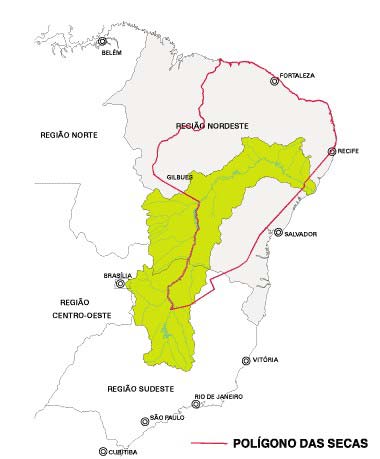
The São Francisco is the third largest river in Brazil having a length of 2 700 km. Its drainage basin
covers an area of about 640 000 km2 representing nearly 8% of the Brazilian National Territory
(Figure 2.1). The river headwaters are located in the state of Minas Gerais and also drain areas of the
States of Goias, Bahia, Pernambuco, Alagoas, Sergipe and part of the Federal District (Figure 2.1).
The basin contains areas of 503 counties with a total population of about 15 million inhabitants; most
of them concentrated in the upper watershed.
Figure 2.1.
São Francisco Basin: Map (a) (LHS) location in relation to Brazil and States of the country.
Map; (b) (RHS) location in relation to the northeast drought polygon (CODEVASF, 2000).
Along its path, the river crosses a diverse region, both in climatic and physical characteristic as well as
in environmental and social diversity. As a result, the watershed is usually divided into 5 regions:
Upper; Middle; Lower Middle; Lower Sub-Basins; and Estuary and near Coastal Areas (Figure 2.2).
Table 2.1 shows the main physical characteristics of each of the regions. It shows that: (a) the upper
basin is wet and yields 70% of total basin flow where urban development, agriculture and hydropower
are the main water uses; (b) In the middle region, water sustainability in the left margin is supplied by
an important aquifer but water demand has increased in agriculture and it constitutes an important
water use conflict together with its environmental impact; (c) In the lower middle and lower sub-
basins, the important features relate to changes in the environment due to hydropower exploitation, the
lack of the water outside of the main river and population sustainability.
Hydropower production plays an important role in the basin. It is one of the national energy sub-
systems. The total installed hydroelectric power capacity in the entire basin is 10,433 MW(e). A
cascade of 8 hydroelectric power dams control most of the annual floods originating in the upper and
middle São Francisco basin regions.
2.2.2. Institutional Development
The Master Plan for the Development of the São Francisco Valley (PLANVASF) was concluded in
1989 by the government and was designed to provide incentives to both the public and private sectors
- 4 -
for the development of the basin. The plan included the development of water and natural resources,
irrigation, power generation, water supply and sanitation, navigation and environmental protection.
However, the Plan was not implemented due to differences in state interests, institutional and political
changes and lack of an integrated systems approach. Regional economic development has been the
main concern in the watershed and environmental issues have been a secondary priority.
Figure 2.2.
Sub-regions of the São Francisco River Basin
Despite the existence of the Basin Master Plan, investment and overall development was made
through sectoral interests such as agriculture, energy and industry. Because the basin lies in six States,
there were also State investments in urban development as well as those related to industry, agriculture
and infrastructure, such as roads, urban water supply and sanitation. The São Francisco Basin
Committee was created in the 1980s but its role was minimal due to lack of legislative support,
government commitment and economic resources.
As discussed in the previous section on Brazilian water development, the country is at the stage of
decentralizing and improving water management through the Basin Committee. The commitment to
this institutional development increased after 2000 with federal support in which the State Secretariats
provided strong involvement. This project played an important role in this ongoing water development
phase in the San Francisco Basin as described below.
With the creation of the Basin Committee and sub-committee, comprising the stakeholders, during the
period of the project, the future challenges are the institutional development of the Basin Agency that
will implement the decisions and measures adopted by the Committees and the decentralization of
basin management through the State Basin Committee and sub-committee.
3. SCOPE, OBJECTIVE AND EVALUATION
3.1. Project Objectives and UNEP Mandate
Main physical characteristics of the sub-regions
- 5 -
Region Water
Physical Socioeconomics Main
water and environment
Characteristics
issues
Upper:
About: 1,500 Annual mean
· Large urban
· Urban development impacts:
rainfall; altitudes ranging from
development in
floods, urban drainage and sewer
Headwaters to 1,600 to 600 m; 20 l.s-1km-2
Metropolitan area of
effluents,
the city of
of mean annual flow and the
Belo Horizonte;
·
Pirapora
Heavy metal releases from
Q95 5 l.s-1km-2 Rain period is
Mining;
untreated industries and processing
from November to March;
· Hydropower production
mill discharges;
Drought period from June to
(Três Marias reservoir); · Natural vegetation removal for
August.
· Agribusiness: crop
agriculture: soil erosion;
production and cattle
· Hydropower impacts on the natural
ranching.
environment.
Middle
Great rainfall gradient,
· Agriculture: left margin
· High water demand due to
ranging from 1,400 mm to 600
annual crops at
irrigated agriculture;
Pirapora to
mm in the its downstream
Barreiras; irrigation
·
Sobradinho
Agriculture impacts due to
limits; left margin basins have
perimeters at right
pesticides from irrigated
great natural regular flow and
margin in Jaiba and
perimeters;
right margin basins aquifer are
tributaries
· Lack of water outside of main river
more limited; 12 l/(s.km2) of
· Navigation: main river;
in the right margin;
mean annual flow and the Q95
· Cattle ranching: mainly
· Sediments transported to the river
3 l/(s.km2)1; same wet and dry
at upstream part.
(causing sedimentation and river
season as Upper Basin;
siltation).
Lower Middle Rainfall 350 800 mm and
· Hydropower: 10,154
· Sediments trapped in the reservoir;
Pot. evapotranspiration ~
MW or 97.3% of the
·
Remanso to
Evaporation on the reservoir
2200 mm; Wet period is from
total is generated in this
Paulo Afonso
represents about 20% of the mean
December to April; Dry period
region (including the
flow;
from July to September;
Xingó Hydropower
· Lack of water outside of the main
minimum flow in the main
Plant located just
river during most of the time;
river, without the dams would
downstream of Paulo
· Strong rainfall variability from
be 523 cms, however with the
Afonso);
year to year and high impact on
reservoirs; the minimum
· Irrigated agriculture
basin flow yield.
annual flow is 1798 cms; In
near the main river.
the sub-basins the mean
annual flow is 3 l/(s.km2) and
the Q95 is near zero1;
Lower and
Mean annual rainfall between
· Hydropower at the
· Sediments reduction was from 6 to
coastal
800 1,300 mm; Wet period
upper region limit;
0.4 millions tons/year. Clear water
is from January to May; Dry
·
and reduced channel depth have
Paulo Afonso
Agriculture;
period from August to
caused proliferation of toxic algae
to the Atlantic
· Navigation;
October.
affecting river biota;
Ocean
· Fishing
· Tourism
· Lack of floods due to reservoir
regulation impacted access for the
fishes to the marginal or riparian
lagoons for hatching. The number
of families that depended on
fishing reduced from 38,000 to
20,000 in recent years;
· Coastal erosion due to the lack of
river sediment supply to the mouth
of São Francisco River.
1 5% of the time the flow is below Q95, obtained from the flow duration curve.
The major SFRB needs were presented in the project document as follows:
· Urgent need for incorporation of land-based environmental concerns into development
policies, plans and programmes for the São Francisco River Basin for the purpose of protection
of its coastal zone.
· Urgent need for implementation of an integrated approach to management of the SFRB
watershed and coastal zone.
- 6 -
The GEF São Francisco project meets the objectives of GEF Operational Program #10 in
International Waters specifically in respect to Land-based Activities Demonstration Projects. The
project identifies specific strategies, investment projects and activities that meet the GEF criteria,
catalyze preparation of an integrated Watershed Management Program (WMP), and serve as a
demonstration project for the implementation of the Global Programme of Action (GPA) for the
Protection of the Marine Environment from Land-based Activities in Latin America. The proposed
actions are consistent with the GEF principle of linking project elements with major cross-cutting
issues, such as land degradation, with the UNEP Environmentally Sound Management of Inland
Waters (EMINWA) integrated watershed management planning process and related Regional Seas
Programme. The proposed actions are also consistent with UNEP's role under the GPA.
The results planned were:
· Improved river basin and coastal zone environmental information to the public and scientific
awareness and knowledge within the basin and its coastal zone.
· Improved public and stakeholder participation through hands-on involvement of communities
in remedial measures.
· Improved organizational structure and staffing capabilities needed to implement financial
mechanisms for water rights and water charges as provided for under federal law 9433/97.
· Improved quantification of water use, use conflicts and hydrological management.
· Improved integrated management and environmentally sustainable development of the SFRB.
3.2. Project Components
The project was developed through the Diagnostic Analysis of the Basin (DAB), of which the main
components were specified in the project document. This was to be followed by the formulation of a
Strategic Action Plan (PAE). The overall planned studies specified in the project document and the
anticipated results are given below.
3.2.1. Diagnostic Analysis of the Basin
The DAB Diagnostic Analysis of the São Francisco River Basin and Coastal Zone was initiated in
January 2000 and presented a causal chain of the problems and the specification of remedial actions.
The DAB preceded the PAE the Strategic Action Program for Integrated Management of the Basin
and Coastal Zone and was presented in a published report (Brasil, 2003).
The DAB was prepared based on 28 sub-projects developed in the period referred to above. These
projects were selected in the PDF-B phase of the project based on a number of seminars in different
areas of the basin. The projects were organized into four components:
I.
Environmental Assessment of the Basin and its Coastal Zone: Quantification of
environmental issues identified in the preparatory phase; identification and quantification of
the impacts of land-based activities and flow regulation in the São Francisco river;
identification of the most likely changes of the river bed, fauna and changes observed;
development of a quantitative basis for the determination of strategic action for multiple
water use.
II.
Public participation and of the stakeholders: Evaluation of land use; identification of the
roles of individuals and institutions in the basin; development of a case study demonstrative
of sustainable water use in irrigation; development of a capacity building program.
III.
Development of the Structural organization: Development of the institutional capacity for
the creation of the São Francisco Basin Committee.
IV.
Formulation of the Strategic Action Programme for the Integrated Management of the
Basin. Based on the results of the three other components develop the Strategic Action
Programme for the Basin.
- 7 -
3.2.2. Strategic Action Programme
The SAP was developed from July to November 2003. This programme was developed based on a
strong public participation of about 12,000 participants and 404 institutions through 217 events such
as workshops (Brasil, 2004).
The structure of the SAP is based on Strategic Actions and components. The two components are the
following (Brasil, 2004):
I.
Implementation of the integrated system of Water Resources Management of the Basin and
Coastal Zone (SIGRH). Four actions are related to this component:
I.1. Strengthening institutional relationships among programmes and institutions at different
levels: federal, state, municipal, basin committee and agencies. This cooperation is to
improve regulation, criteria, strategies, monitoring, conflict management and water
permitting. This action has two activities: (I.1.1) links between programmes run by federal
bodies and water resources and environment management systems of the federal, state and
municipal governments, and other stakeholders in the basin; and (I.1.2) support for the
setting of licensing criteria, water-use charges, guidelines for management of conflicts and
the definition of monitoring strategies.
I.2. Implementation of institutional instruments for the SIGRH and public participation:
Implementing an effective system of public participation at different levels. This action has
the following activities: (I.2.1) Support for the São Francisco Basin Committee through
implementation by the Water Basin Agency and the establishment of an inter-institutional
research network, state water resource management systems, and the provision of training for
members of the Integrated Basin Management System; (I.2.2) Support for the
implementation of a planned system of models providing for interactions among sectoral
policies.
I.3. Development of technical instruments of the SIGRH: Developing the tools required for
databases and monitoring; and hydraulic, hydrologic and water quality mathematical models
for basin management. This action comprises the following activities: (I.3.1) Support for
regularization for water resource use, for monitoring and registering uses, implementation of
an information system for the São Francisco River Basin and its coastal zone, and for
establishment of a database for integrated basin management; and (I.3.2) development of
hydrologic, hydraulic and water quality models and decision-making support systems.
I.4. Social mobilization and environmental education taking into account the regional
characteristics and historical values. The activity associated with this action is: (I.4.1)
Promotion of social mobilization and environmental education. It includes the drafting of a
plan that respects regional differences and the creation of a metadata base for the basin,
which includes historical documents.
II.
Sustainable use of water resources and environmental rehabilitation of the basin and its
coastal zone.
II.1. Promotion of multiple uses of water and its rational water use: Development of activities to
improve the rational use of water, efficiency and environment conservation. This action has
the following activities: (II.1.1) Support for rational use in irrigation; (II.1.2) Follow-up for
hydro-environmental and operational studies on multipurpose use of dams, including the
generation of artificial floods, with the aim of providing support for shipping and resolving
problems in the coastal zone; and (II.1.3) support for rehabilitation of icthyofauna and
fostering of fisheries and aquaculture.
II.2. Conservation of water, soil and biodiversity: Erosion control, recovery of degraded areas,
control of non-point pollution, conservation units and vegetation recovery. This action
comprises the following activities: (II.2.1) Support for the restoration and preservation of
remaining vegetation, control of erosion, restoration of degraded areas and measures to
- 8 -
control specific sources of point and non-point pollution; and (II.2.2) Support for the creation of a
conservation unit at the mouth of São Francisco River and its Coastal Zone.
II.3. Access to environmental sanitation and flood control measures: Support poor communities
for sanitary sustainability and develop emergency measures for extreme events. This action
has the following activity: (II.3.1) Cooperation for access to environmental sanitation for
poor communities and the adoption of measures to manage floods and droughts;
II.4. Sustainable use of groundwater: Sustainable use and groundwater protection for the basin
aquifer. This action has the following activity: (II.4.1) Dissemination of knowledge on the
management, utilization and protection of aquifers in the basin, and the establishment of
guidelines for sustainable exploitation of the Bambuí and Urucuia aquifers.
3.3. Evaluations
3.3.1 Methodology
Each sub-project was evaluated in terms of its success on a scale from 1 to 5 (Table 3.1) with 1 being
the highest (most successful) rating and 5 being the lowest. In rating the projects, the criteria used
were: Timeliness: how the project met the schedule and implementation timetable cited in the project
document and later revisions thereof; achievement of results/objectives: the extent to which the
project's environmental and development objectives were achieved; Attainment of outputs,
Completion of activities, Project budget, Impact created by the project, Sustainability, Stakeholder
public participation, monitoring an evaluation.
The procedure used in evaluating each project was the following:
(a) Most of these sub-projects were evaluated in the mid-term evaluation. By the time of this terminal
evaluation, many of the sub-projects had provided additional results to those available at the time
of the mid-term evaluation. In the case of sub-projects completed before the mid-term evaluation,
the evaluations have been revised;
(b) For each project a mean grade based on the scale of table 3.1.was calculated The overall rating
was not the mean of each criteria of the project but an overall evaluation of the project based on
the visits and interviews.
3.4. Project Performance
Table 3.1.
Evaluation Ratings
Rating*
Qualitative Rating
Achievement of the Project
%
1 Excellent
90
-100
2
Very Good
75 -89
3 Good
60
74
4 Satisfactory
50-59
5
Unsatisfactory
Less than 59
*the lower the rating, the better is the project
3.4.2. Overall Evaluation and Evaluation of Sub-Projects
The detailed evaluation for each sub-project is presented in Annex A. The evaluation verified the
results of sub-projects based on documentation, interviews with individuals involved in a cross-
section of projects and visiting the area. A summary of the evaluation ratings for each sub-project is
presented in Table 3.2
- 9 -
Table 3.2.
Individual and Overall Ratings of Sub-Projects
t
t
t
eated
ojec
Sub-Project
s
i
es
t budge
pr
i
evemen
p
a
ct cr
r
ojec
Component
Timeliness
Ach
Attainment of
output
Completion of
activit
P
I
m
by the
Sustainability
Public
monitoring
Activity
Rating
I 1.1a
Hydrodynamic and Sedimentation Study of BSF, estuary
2
2
1 1 2 2
2
2
1
1,67
and adjacent coastline. (AL/SE)
1.1b
Nutrients level determination at SFRB mouth region and
3
3
2 3 2 3
3
3
2
2,67
impact of artificial flooding over its control. (AL/SE)
1.1c
Evaluation of the potential for navigation to contribute in the 4
2
2 3 3 2
2
2
3
2,56
increment of the agriculture competitiveness at SFRB.
1.2
Impact of mining on water resources in the Rio das Velhas.
2
1
1
1
2
1
1
1
1
1,22
1.3
Fisheries impacts on Migratory fishes in the middle SFRB.
3
1
1
1
2
1
1
2
1
1,44
1.4
Development of a water quality monitoring system in the
2
1
1 1 2 1
1
1
1
1,22
lower middle SFRB.
1.5
Impact of agriculture on groundwater in the Rio
5
3
3 3 4 3
3
2
3
3,22
Verde/Jacare.
II 2.1
Determination of land use in the Lower-middle
SFRB.
1
1
1 1 1 1
2
1
1
1,11
2.2a
Partnership to improve Ribeirao São Pedro's water quality.
4
2
2 3 4 2
3
1
2
2,56
(MG)
2.2b
Recovering our forests (MG)
1
1
1
1
1
2
1
1
1
1,11
2.2c
Multi temporal analysis of the dynamic alteration in the river 1
1
1 1 1 1
2
2
1
1,22
bed morphology.
2.4
Study of the bank erosion processes, and the relative effect
2
2
2 2 3 1
2
2
1
1,88
over the river sedimentation dynamics. (AL/SE)
III 3.1
Pilot implementation of Federal Water Policy in the
3
3
2 3 3 3
3
2
2
2,67
Maranhão River.
3.2
Conjunctive use of Surface and Groundwater
4
2
2 2 3 2
2
2
2
2,33
3.3a
Capacity building for participative organization of water
4
3
3 3 3 3
3
2
3
3,00
resources and environmental education.
3.3b
Integrated Managing Plan in the Rio Salitre's basin. (BA)
1
1
1 1 1 2
1
1
1
1,11
3.5
Support the strengthen of the Water Basin Committee in the
3
3
3 3 3 2
2
1
2
2,44
SFRB.
IV 4.1
Promotion of public participation in the SFRB
2
2
1
1
2
1
2
1
1
1,44
4.2
Evaluation of financing mechanisms for sustainable
3
3
2 2 2 3
3
2
2
2,44
watershed management in the SFRB.
4.3
Needs Assessment for the Quantitative Evaluation of Water
3
1
1 1 3 2
1
2
1
1,67
Use and Use conflicts in the SFRB
4.4
Determination of the Operational Policies for Major
2
2
1 2 2 2
2
2
2
1,88
Reservoirs in the SFRB
4.5
Formulation of an Integrated Basin and Coastal Zone
3
2
2 1 2 2
2
2
2
2,00
Management Program.
4.6
Events of public participation to support the preparation of 2
2
2 1 2 1
2
1
2
1,67
the Plan of Strategic actions for the management of the
SFRB
4.7a
Proposal for the Complementation of the SFRB
3
2
2 1 2 1
2
2
2
1,89
hydrometeorogical network
4.7b
Proposal for a Piezometric Monitoring Network on Verde
3
3
2 3 3 3
3
2
2
2,66
Grande river sub-basin
4.7c
Metadata-based information reference system
3
2 2 2 2 1
2
2
2 2
4.7.d Decision Support System
3
2 2 2 2 1
2
2
2 2
The overall rating for the project is "Excellent" with an achievement rating of 90 100%. The ratings
r are presented by criteria in Table 3.3 below. It can be seen from this table that the aspects awarded
the highest ratings related to attainment of outputs, completion of the activities, impacts created by the
project, public participation and monitoring. The timeliness of project development, budget and
sustainability were the criteria that were awarded a rating at level 2.
- 10 -
Table 3.3.
Criteria and Overall Ratings
Criteria Description
Overall
Rating
Timeliness:
How the project met the schedule and implementation
2
.
timetable cited in the project document and later revisions
thereof
Achievement
Achievement of results/objectives (the extent to which the
1
project's environmental and development objectives were
achieved).
Attainment of outputs.
1
Completion of
1
activities.
Project budget.
Project execution within the budget
2
Impact created by the
1
project.
Sustainability
2
Stakeholder Public
Involvement
1
Monitoring
Monitoring and evaluation
1
3.4.1. Project Management
Project Management and Monitoring
At the inception of the project its management was housed at SRH Secretary of Water Resource but
was later was transferred to ANA National Water Agency. During this period there was some delay on
signing of the Terms of Cooperation between the project and the federal, state, municipal agencies and
non- governmental organizations, to define roles responsibilities and local coordination approaches.
Local project management at ANA has been a small and effective unit achieved very good
coordination with OAS. The project management was efficient based on following aspects:
(a) There were special emphasis to the project management and monitoring techniques. In
January 2002, a seminar was held with the project team, as well as technical and management
consultants to evaluate the methodological, technical and financial aspects of each sub-project;
(b) In 2002, several meetings were held between the sub-project coordinators and the technical
coordination including the participation of the National Director and the International
Coordinator;
(c) A Project Operations Manual and a Guide for Preparation of Partial and Final Reports was
prepared and distributed. Coordinators and consultants learned to prepare consistent
procedures for technical report preparation.
(d) Technical Coordinator provided guidance to the sub-project coordinators and consultants in
the preparation of the Final Reports. .
(e) The management promoted common activities among sub-project for exchange of
experiences, knowledge and cooperation
Financial Management and Co-Financing
- 11 -
The overall financial expenditure of the project shows the following; (a) Technical management unit
was small and its cost were low taking into account the overall expenditure; (b) the cost of the
activities (sub-projects) were reasonable.
The delays in transferring funds to the projects occurred at the beginning of 2001 during the transition
period of the National Coordination of the Project from SRH to ANA. All these issues have been
solved. As the sub-projects learn more on report formatting and quality requirements, approval of
payments can be performed more expeditiously (UNEP, 2004).
Co-financing is understood here as the quantity of resources supplied by other agencies for the
purposes of project implementation. The main investment planned for financing for the project was
those of: GEF, US $ 4,771 million; WB PROAGUA, US $ 8,645 millions; and the US Government,
$ 8,543 million. GEF investment was implemented together with the Government counterpart
investment as presented in Table 3.4.WB PROAGUA was not implemented. There is a distinction
between WB - PROAGUA mentioned as fund source for this project and PROAGUA semi arid
programme which is an investment from the WB in the region of São Francisco River Basin. The first
are funds from the second and were anticipated as additional funds to address the project objectives.
The funds of PROAGUA semi arid programme have been invested in the region of São Francisco, but
the funds of WB - PROAGUA were available to this project because there was a reduction of about
US $ 100 millions in the funds of the PROAGUA semi arid programme (about 25% reduction). This
reduction was due to the country counter-part reduction in the project due to budget limitations. It
represented a reduction of about 38% of funds for this project, and which were intended for use in
increasing the number of pilot studies in the sampling the components of DAB. However, it is
believed that this did not have a major impact on the final conclusions and in developing the SAP.
From the interviews and knowledge of the institutions in the region, it was found that most of the
institutions involved in the project provided important support as specified as follows: (a) qualified
personnel, as the projects paid only small part of the costs of the personnel; (b) equipment,
infrastructure from co-financers such as counties, states and others; (c) funds for travel and other
services to complement the project budget; (d) funding for other projects that provide synergy for the
conduct of research. Also, there are many projects developed in universities and research centers that
receive scholarships for students and research personnel. Estimates were made of these contributions
to the project and are presented in the Table 3.4. The project coordination did not present the
distribution of the funds of table based "in kind" and "cash" contribution. The amount planned for the
project for country counterpart contribution was US $ 8,543 millions and the total country
contribution was US $ 9,651 which was more than one million above the planned amount.
3.4.2. Achievements
In the project achievement evaluation, the planned activities of the project document (ProDoc) and
comments regarding the development of these activities (in italics) are presented below:
I.
Environmental assessment
Quantification of priority issues identified during the PDF phase, thereby updating and
consolidating older data and providing for the forecasting of potential future scenarios
within the linked land, water and marine system.
This activity was developed. An assessment of the environmental scenarios related to
sediments in the coast and the relationships of the nutrients, fauna and flora were developed.
The project evaluated the environmental scenarios related to sediment transport to the coastal
zone and the associated influence on nutrients, fauna and flora.
Table 3.4.
Government in kind co-financing Estimation (Source: project coordination)
Activities Co-financing
- 12 -
US $ millions
Project component
I- Environmental Assessment of the Basin and its Coastal
483
Zone
II - Public and stakeholder participation
265
III - Development of the structural organization
900
IV - Formulation of the Strategic Action Programme for the
807
Integrated Management of the Basin
Coordination 82
Sub-total
2,537
Other government projects in the Basin
Complementary works of São Francisco waterway
1,270
Works of revitalization and recovery of São Francisco River
2,080
Pilot Plan for physical revitalization and environment of São
270
Francisco in Bahia
Program called "Our Rivers: São Francisco"
2,044
Conservation and revitalization of São Francisco Basin
1,451
Sub-total
7,114
Total 9,651
Identification and quantification of the extent to which land-based activities and river
regulation in the Rio São Francisco influence hydrology, water quality (especially, sediment
and nutrient transport), fisheries and aquatic ecology throughout the system and, especially,
in the coastal zone in the vicinity of its estuary.
Land use evaluation of part of the São Francisco River Basin was prepared. Sediment
mobilization and the effects of reservoirs and hydrologic variability were evaluated. The
climatic variability reflected in the hydrologic series (i.e., the long-term record of flow in
the river basin) and the dam trapping of sediments were the main causes of the reduced
sediment supply to lower reaches of the river and its estuary. This change had important
impacts on the environment and the sustainability of fisheries.
Provide the quantitative basis for the determination of strategic actions to optimize the
multi-purpose utilization of water resources of the basin and the protection and restoration
of the coastal zone ecosystems currently adversely affected by land-based activities.
Some activities were developed as a pilot project to educate the population in land
conservation and the development of sustainable practices. This activity was successfully
developed with stakeholder participation and coordination.
Component II: Public Participation and Stakeholder Involvement
Mapping at an appropriate scale to determine land ownership and condition and a
framework for establishing water use allocation system.
This activity was developed for part of the basin and in pilot studies. The practices
developed improved the expertise and knowledge of the technical and research groups in the
basin.
Identification, and establishment, of coordination among individuals and agencies having
commercial or institutional responsibilities within the basin, including within the fisheries,
navigation, mining and agro-industrial sectors, the public and all levels of government.
- 13 -
The identification of stakeholders and the development of relationships were the first steps taken in
order to construct the Basin Committee and the sub-basin and regional committees.
Demonstration of sustainable agricultural and stream-bank management measures for
implementation under community-based land management programs (supported through the
World Bank-financed PROAGUA programme that will demonstrate sound soil and water
management techniques, appropriate utilization of agro-chemicals, and improved methods
of crop management, irrigation design and maintenance of infrastructure such as roads and
irrigation ditches).
This activity was partially developed in two pilot studies. Land conservation and
community-based management was mainly developed but crop management aspects were
not developed.
Creation of community-based information and training programmes to support community
land management programs.
This activity was developed through pilot projects.
Component III: Development of the Structural Organization
An evaluation of the efficiency of several policy instruments for implementing the Water
Law and related state legislation.
These activities were developed in a few sub-projects that support the SFRB Committee and
sub-committee in regional areas, the creation of Basin Agency and the mechanisms of water
charge for economic sustainability of the system.
Pilot-scale implementation in order to relate measured improvements in both the rate of
water use and the degree of protection of downstream water quality.
A study related to this activity was developed in the Salitre Basin with important results as a
pilot demonstration.
Development of a framework for the implementation of the Law in other sub-basins.
The Water Law instruments were developed in the regionalization of the basin through the
sub-committee and in State sub-basins. These activities were well described in project
documents.
Component IV: Formulation of the Strategic Action Programme for the Integrated
Management of the Basin
The conduct of workshops and training programs for officials and community leaders and
informational campaigns within schools, civic groups and communities.
These activities were successfulyl developed with a large number of representatives
participating in different parts of the basin.
The convening of two international seminars to facilitate discussion of water resources
issues of priority concern as a means of building appreciation for the unitary nature of the
São Francisco river hydrological system and related coastal zone.
The project supported regional events such as the Water Resources Symposium in Northeast
Brazil in Maceio, which is the main regional event that occurs every two years, and
workshops but there is no mention of international events in project documentation.
The dissemination of the experience gained in the determination and initial implementation
of management actions through the professional literature, seminars, public information
meetings and training programmes to enhance the transfer of knowledge as encouraged
under Chapter 15 of Agenda 21.
- 14 -
The publication of the results of the project in the technical literature is being carried out by
researchers and other professionals. The results will be presented at meetings and
conferences including the Water Resources Symposium and other events in Brazil.
Dissemination of information to the general public has been done through pamphlets,
webpages and videos.
The use of, and support for, the Inter-American Water Resources Network (IWRN) as a
means of disseminating information regarding the conduct and findings of this activity.
The results of the project have been presented by the OAS and other professionals in the
network meeting and the documents have been distributed through regional professional
events.
The development of a framework to extend and harmonize the existing hydrometeorological
data collection network, unifying data gathering objectives and methodologies in order to
enhance the dissemination of data and information throughout the basin.
The plan for an updated monitoring network of data collection in the basin was prepared, a
metadata information system was developed and the Hidroweb system (Brazilian hydrologic
data bank of the ANA) has become the base for hydrologic information on the basin.
3.4.3. Stakeholder Involvement
This project has maintained involvement of relevant stakeholders in most of the sub-projects. The
mean rating of the sub-projects was excellent. The main stakeholder commitments to the sub-projects
were in:
· The development of the SFRB Committee, sub-basin and regional committees: The
Basin committee was established after many public workshops where all stakeholders
were represented. The achievement was attained with the involvement and support of
State Water and Environment Secretary (commitment from the authorities) and public
awareness on water issues in the basin. The regional committees were developed from
the SFRB Committee as a means to decentralize the management in a basin of large
dimensions (> 600,000 km2). The sub-basin committee was developed based on the
State's initiative and preceded the SFRB Federal committee. A major challenge is to
integrate the overall basin issues and management with the local view of the State
committee which are from small basins. In order to connect the State sub-basin
management to the SFRB basin management The following approaches were adopted:
(a) Within the project there were sub-projects focusing on these basins and (b) the State
Secretaries, other stakeholders from the States were involved in the Federal Basin
Management.
· Development of conservation measures through land use mitigation programmes;
· Discussions and the evaluation of impacts in some watersheds; and
· Identification of primary issues, evaluating and proposing components at different levels
of basin planning.
3.4.4. Sustainability
The project had a strong commitment from Federal and State agencies, universities, research
institutions, some private companies and NGOs. The strong commitment was due to: (a) involvement
of high ranking public officials in many steps of the basin Institutional construction. The State
Secretaries participated in the Basin Committee. The presidency of the Committee was the
Environment Secretary of Minas Gerais who was also the former Ministry of Environment. This was
an important asset in the success of the revised institutional arrangements; (b) the State and Federal
Research Institution played an important role in donating infra-structure and manpower; (c) NGO and
public workers from all levels donated much of their time for many activities in the committee,
workshops and other sub-projects.
- 15 -
The project acted as an important catalyst for the involvement of all these institutions in the
development of activities. This aspect was rated as "very good" as the mean of all sub-projects.
In the region, there were many investments from different sources for sectoral development purposes
in energy, agriculture, transport and infrastructure generally or with a specific focus on research and
conservation.
The creation of the institutional framework for the Basin Committee and, in the future, the Agency
with its funding derived from water use charges will be the basis for the sustainability of the project
and the future implementation of the Strategic Action Plan.
Under current conditions, because the Agency and the mechanism for water charges have not yet been
implemented the economic sustainability of the basin is still weak. It will be developed in the future
activities steps of the project, as planned. Nevertheless, even if funding of the follow-on activities
were not forthcoming at this stage, the institutional development of the basin and associated plans
would be delayed but the institutional process is strong enough to continue.
3.4.5. Scope, Quality and Significance of Project Outputs
The evaluation presented below was developed by taking the main projected outputs of the project
document (ProDoc) and providing commentaries about the results obtained (in italics).
Component I: Environmental Assessment of the Basin and its Coastal Zone
An inventory of the aquatic fauna, flora and hydroclimate in the lower SFRB and historic
changes in its characteristics.
The studies developed in the lower Sào Francisco River Basin permitted important
knowledge to be gained of the actual conditions, impacts and required mitigation measures
for the environment and social sustainability. The study produced good outputs in achieving
this objective.
An evaluation of the environmental impacts of the river on the coastal zone including
wetlands, beaches and fish habitat.
The study identified the impacts of climate and dams in the Lower River and coastal zone.
The relationships between the physical effects of the reduction of suspended sediments and
fish, flora and coastal sustainability have been identified in the project.
An analysis of floods and the use of artificial floods as a hydrological management
mechanism.
During the last decade, mainly following the 1990s, floods have been of small magnitude in
the São Francisco River Basin but have significantly decreased the sediment supply to the
Lower River and Coastal Zone. This is the result of a combination of hydraulic structure
impacts related to dams and climatic variability over a long period. There were some plans
to develop artificial floods but some conditions have changed: (a) previous to 2004, the
energy production of the São Francisco was at the limit and the reservoirs were almost
empty; (b) In 2004, there was a flood that simulated appropriate flood conditions for
improving the environment downstream.
An assessment of different scenarios for reservoir operation to minimize environmental
impacts on the estuary and coastal zone.
Several flood conditions were evaluated and the situation that developed in 2004 provided
an example of real flood conditions.
- 16 -
Component II: Public Participation and Stakeholder Involvement
A sound basis for determining land ownership together with a framework for establishing a
water use allocation system will contribute to the rational allocation of water and the setting
of water charges.
Land-use evaluation was developed for some parts of the basin in order to understand
relationships with impacts. In other sub-projects, evaluations of water use, the basis for
water use charges and the mechanisms of basin system sustainability were developed.
Strengthened community-based and governmental initiatives that contribute to the
identification of water use and its impact on the hydrology of the system to facilitate
implementation of water use charges, including the creation of public, private and public-
private partnerships as appropriate.
The creation of the Committee of the São Francisco River Basin, the sub-committees in the
regional reaches of the river and the development of a few State committees (mainly in the
Upper River Basin) provided an important institutional mechanism for management in the
basin through the participation of public, private and social organizations. Further
proposed action involves the creation of the basin agency to ensure the sustainability of
these mechanisms.
Pilot-scale demonstration projects to identify methods of stabilizing degraded lands and
riparian areas and the promulgation of appropriate remedial measures.
Some projects were developed with public participation in order to improve soil
conservation and to address other environmental issues. Activities were developed to
improve conditions mainly through preventive measures.
Component III: Development of the Structural Organization
A framework for the creation of a financially sustainable basin management agency that will
contribute to the sustainable use and management of the water resources of the basin,
including the integration of environmental and coastal zone concerns into the overall
management strategy for the system.
The Strategic Action Plan has, as a priority, the development of the Basin Agency. During
this project, some of the important elements for the Agency framework were developed that
will help in the creation of this component of the institutional structure for the basin.
The establishment of an integrated river basin committee consistent with the spirit of
Federal Law 9433/07 and, inter alia, the Maranhao River sub-basin, for potential extension
to the entire SFRB.
The SFRB Committee was created and has developed an important role in the institutional
framework for water use management in the basin.
A framework for the conduct of inter-agency discussions within a multi-purpose basin
through the creation of a forum for the interaction of sub-basin committees and water
agencies with members of the public and stakeholders participating in the decision-making
process.
Sub-basin committees were created and regional discussions have been held on the
institutional base of the committee.
Experience with institutional mechanisms for the management of the basin has provided an
important lesson to be learnt in the context of the dimensions of the basin and institutional
conditions pertaining to a federated state.
- 17 -
Component IV: Formulation of the Strategic Action Programme for the Integrated
Management of the Basin
Meeting and workshop reports
Meetings were convened in Brasilia and in each basin region where the PAD (i.e, the
Strategic Action Programme or SAP) was discussed together with many participants drawn
from the public and private institutions.
A compendium of appropriate methods and the means of integrating community-based
decision making into the structure and function of the integrated basin management
committee proposed to be created under component III.
The creation of Basin Committee and sub-committee in the context of their relationships
with the government committees and the legislative regime at federal and State levels has
been one of the major challenges in the development of institutional framework. This is an
on-going and continuous process that will result in revisions and adjustments over time.
A regional water information system, including the publication of a magazine for basin-wide
distribution to raise awareness, build participation and inform citizen across sectoral lines.
Some actions were taken related to this output: a webpage for the basin; a metadata system
that includes all publications of the institutions related to the SFRB, folders, videos and
publications that provide information to the public.
A framework for addressing priority issues inherent in the management of the SFRB.
In the developing the Strategic Action Programme, a chain of causal relationships of issues
was developed that provided a guide to the identification of strategies for the basin and
specification of required investments.
4. FINDINGS AND CONCLUSIONS
The findings are organized in relation to three major criteria: environmental assessment, water
resources management and institutional arrangements.
4.1. Environmental Assessment
(1) The prevailing belief was that there was a process of desertification in Cabrobó semi-arid region of
Pernambuco in Lower Middle of San Francisco. The study carried out under the project showed
this not to be the case (Project 2.1).
(2) One of major issues mentioned by some professionals and members of the population was that
saline intrusion of the São Francisco had been increased following dam construction upstream.
The project studies showed that this was not true. In fact, the dams decreased the extension of
influence of the saline intrusion (Projects 1.1a and 1.1b).
(3) The knowledge developed regarding sedimentation and erosion processes, nutrient loads and
possible mitigation practices to recover the icthyofauna in the Lower São Francisco was an
important finding for the region.
(4) An evaluation of mining impacts on the water resources in the Velhas River near the Metropolitan
Region of Belo Horizonte. This evaluation has supported the discussions and decisions relating to
the control of such impacts in the Upper River Basin.
(5) The development of a water quality index, training the population and creating a cadre of
volunteers for evaluating the water quality of the rivers.
(6) The evaluation of basin land-use, associated changes with time, sediment yields and bed
modification together with improved knowledge of hydrologic behavior allowed understanding of
the impacts in the lower river and coastal zone. The reduction of sediment loads due to the
- 18 -
combination of hydrologic conditions (low floods in a sequence of years) and reservoir effects
reduced the sediment supply to the lower reaches to levels about 10% of those of former years
thereby decreasing nutrient loads, increasing coastal erosion and decreasing river turbidity
allowing the proliferation of macrophytes in the river.
(7) The practice of recovering part of the natural vegetation, mainly near the rivers, has been
successfully developed in collaboration with NGOs in a pilot project with concrete results (Project
2.2b). Such practice constitutes an important experience to be transferred.
4.2. Water Resource Management
(8) The contribution of navigation to the development of agricultural competitiveness will facilitate
government decision-making.
(9) The use of models to evaluate the basin behavior taking into account the hydropower and other
water uses is an important experience in the synergetic integrated environment assessment
which can be used in other basins.
(10) The impact of water use in agriculture was evaluated together with its efficiency and the value of
the water in terms of the production and export of goods. This chain of economic value is an
important requirement for decision-making regarding basin development.
(11) The water resource plan developed in a pilot project (Project 3.3b) constitutes an important
resource for the future development of basin management in the SFRB.
4.3. Institutional Arrangements
(11) Substantial public participation (~12,500 persons) in project activities and in the development of
the Strategic Action Plan has been important to validate the decision-making process in the basin.
(12) Capacity building at different levels has been one of the major assets of the project in the areas of:
(a) soil conservation; (b) water quality evaluation; (c) understanding environmental and water
resources issues and sustainability; and (d) public participation in committees.
(13) The development of a proposal for updating the hydrologic system network is a relevant aspect
that requires special attention in subsequent project phases because, without reliable information, it
would be impossible to develop a sustainable management mechanism.
(14) The implementation of the São Francisco River Basin committee and its consolidation during
recent years has been a most important output from this project. The development of any public
participatory process is both complex and lengthy involving the building of trust among the people
and resolving conflicts of interest. The following steps are the consolidation of the interactions
among the sub-basins, the establishment of regional committees and implementation of the basin
agency and the social and economic sustainability.
4.4. Conclusions
The project has achieved success in several aspects relating to environment assessment, water
management and institutional arrangements. Some of the main outputs are:
· The development of a project document addressing most of the main issues in the basin. It is
very well orientated document that has provided a firm basis for successful development of
the project. It should, however, be noted that one important issue was not fully included,
namely human sustainability in semi-arid areas outside of the main river of SFRB water
supply influence in the sub-basins. In this region, water is the basis of life in economic, social
and environmental terms. Population of these sub-basins is very poor mainly because of the
lack of water. The reduction of poverty has also a direct link to environment improvement
conditions.
· Project management by the leading agencies involved in project execution was very well
conducted with good standards being maintained in the preparation of reports, reviewing of
products, developing integration, through researchers and technical professionals, of the
- 19 -
various sub-projects and preparing comprehensive documents, folders, videos and other
media for providing public information.
· The project has had some very important benefits for the basin community, the federal
agencies, ANA and SRH, State administrations and the public, including the following: (a)
increased integration among research groups working in the basin in similar or interrelated
areas; (b) the promotion of strong interactions among stakeholders in the Basin Committee has
allowed improved decision-making, which has been spread to State administrations in the
Basin; (c) increased investment of governments through national, state and international
funds; (d) education of the population on water management and environmental issues,
mitigation measures and participation in decision-making processes at various levels.
· The development of the future steps such as implementation of the Basin Agency,
development of Strategic Action Plan, among others are very important in order to assure the
sustainability of the results achieved to date. The results already obtained would not be lost if
the momentum is lost at this stage but it would delay the achievement of the long term goals.
5. LESSONS LEARNED AND RECOMMENDATIONS
The lesson learned in the project relate to project management, environment assessment, water
resource management and the sustainability of management mechanisms. Among the most important
are the following:
Project Management
· In the development of this type of project, it is important to promote integration of sub-
projects through workshops, specific visits and meetings among a few projects that have a
common interest or focus; benefit from the shared use of equipment and laboratories can be
significant.
· It is important to recognize that a GEF project such as this has component activities that
provide a vehicle for collaboration and interaction with other projects and activities in the
basin. This provides increased probability of sustained attention to the basin and the
remediation of problems than would otherwise be the case.
· Technical personnel and researchers learned how to work together, develop integrate
investigations and prepare reports and other tangible outputs for both improvement of
knowledge and public information. The following facotrs helped to enhance cooperation: (a)
sharing equipment, labs, experience and outputs; (b) workshops and exchange visits between
the sub-projects; (c) complementary sub-projects in the same regions.
Environment Assessment
· The interrelationships among climatic variability, dam operating conditions and soil use in a
basin constitute a complex non-linear combination that can lead the ecosystem to different
levels of stress. By understanding the relevant processes, this knowledge that can be used to
prepare terms of reference for impact assessments of reservoirs on hydropower development,
multiple water uses of the system and to improve process characterizations through modeling.
· The approaches used to disseminate public information on environmental and water resource
assessments and mitigation measures provide useful lessons / experience for wider application
in the region.
Water Resources Management and Sustainability
· The São Francisco River is a large basin in a federal country with many states. The federal
legislation (water law and constitution) together with the State legislation formed the basis for
institutional arrangements. However, these legal instruments are not explicit regarding how to
- 20 -
develop the institutional decentralization of basin management through basin committees and
agencies. The experience gained in the SFRB project is singular in this respect (see main
aspects in annex B) and provides a useful model or example for other countries to construct
similar mechanisms. Institutional arrangements are always unique due to the combination of
legal, social and economical circumstances but the successes and failures of the Brazilian
development process constitute a major asset for development of similar arrangements
elsewhere.
· The public participation processes for the development of a Strategic Action Programme
provided very good experience in decentralization and stakeholder participation. The
development of basin committee was based on (a) workshops in different places of the basin;
(b) important commitment of the Federal and State authorities; (c) representative NGOs,
research, educational and private institutions and public.
· It is recommended that in the future development of the program the human water
sustainability in the semi arid sub-basin should be addressed by the project.
6. OVERALL CONCLUSIONS AND RECOMMENDATIONS
These conclusions present an overall view of planning and activities in the project and its relationship
to governance actions in the Water Resource Plan for the SFRB. Below an overview of the national
institutional instruments (legislation and Plans), the main elements of the project and its relationship to
the Basin Plan and the economic support mechanism are presented.
The main legal instrument for water resource development in Brazil is the Law 9.433 of January 1997.
The legislation objectives and framework are based on sustainable development concepts. One of the
main instruments of this policy are the Water Plans developed for the Nation, for the States, and for
basins. The National and State Plans are mainly for development of the country and regional water
policies based on the physical, social and economic characteristics of a given basin. The country
developed its first Water Plan in 1998 and is developing an updated Plan inside the Secretariat of
Water Resource. Most of the States in the country have not yet developed their State Plans. The River
Basin Water Management Plan is the legal document for the implementation of the Water Resource
Policy and management at the local level.
The São Francisco River Basin is a Federal River and its committee includes federal representatives
and those of states, counties, users and civil society institutions. The basin committee has been created
and, during the execution of the GEF project, received more financial support in order to develop
actions relating to water management. The construction of a sustainable water resource management
regime for the basin is based on the committee, the Agency, implementation of the instruments (water
permits, water charges, among others) and decentralization of this process within basins of the size of
SFRB.
The actual and prospective scenario is the following:
(a) SFRB has a functioning committee but does not have a Water Agency to implement the
instruments and the actions decided in the committee;
(b) The basin is too large to have only one committee and there are two decentralization processes:
(b.1) the sub-committees, which have been created (upper, middle and lower basin); (b.2) the State
Basin committee (there are only a few State committees, mainly in the Upper Basin, and there are not
yet institutional interactions between the Federal Committee and the State Committees;
(c) The Basin is in a transitional stage of institutional development and there is an important need to
implement decentralization and to create the Basin Agency.
There are four major projects and studies for the management of the basin, which are strongly inter-
related. They are:
- 21 -
DAB Diagnostic Analysis of the Basin: which developed studies for a diagnostic of the main
aspects related water resources and environment in the Basin.
SAP - Strategic Action Programme: This planned some of the main instruments for the
Integrated Management System of the Basin.
Decennial Water Resource Plan for São Francisco River Basin (2004-2013): This is the
Legal instrument for basin development that takes into account water and conservation
conditions.
PPA 2004-2007: Existing development Plans of Federal and States for the SFRB region.
The first two were developed within the GEF project and the other two are instruments of government
(see Figure 6.1). DAB was the first experience of an integrated evaluation of the São Francisco River
Basin (Brasil, 2004) based on 29 projects and about 12,000 participants in the discussion of results. It
had four main components addressing: environment assessment, public participation, institutional
framework and development of the Strategic Action Programme. This diagnostic analysis allowed the
development of the SAP that was approved in October 2003 by the Basin Committee. In the same
meeting the Basin Committee decided to develop the Water Management Plan based on these results.
The SAP is based on two major actions addressing: the Implementation of IWRM (Integrated Water
Resource Management); and Use and Conservation in the Basin (the sustainable use of Water
Resources and environmental rehabilitation in the basin).
The Terms of Reference for the São Francisco WMP were prepared based on the SAP Strategic Action
Programme developed in the GEF project. The latter has as its main goal the development of an
agenda for the basin that identifies management actions, programmes, projects, works and priority
investments taking into account government institutions, civil society, users and water resource
institutions to contribute to the sustainable development of the basin.
This Water Management Plan has the following objectives: (a) Implement the Integrated System Basin
Water Resource Management; (b) establish the framework of water distribution and sustainable water
use in the basin; (c) establish a framework for revitalization, recovery and conservation of water and
environment; (d) develop an action programme of investment for water, land use and sanitation.
GEF projects are planned and developed to cope with sustainable environmental management; they
are not planned to be an Institutional Development Water Resource Plan. In the SFRB, the DAB and
SAP were developed taking into account the environment aspects and institutional frameworks to
support sustainable development and management. The São Francisco Water Management Plan was
developed using inputs from the GEF project combined with other essential elements of a WMP (see
Figure 6.1).
PPA is the group of investments planned for the region that should be integrated with the Basin WMP.
The objectives of PPA for 2004-2007 are related to social and environment issues, public participation
and increased population income. It has a total of about US $ 660 billion in four years where 90% are
for demand project (Brasil, 2004). This number is not very realistic as the Federal and State
governments do not have the capacity for such a large investment in four years. The main investments
of PPA are related to the improvement of water supplies and waste treatment, efficiency of water use
in irrigation; and improving human sustainability in the semi-arid region. The Basin Water
Management Plan developed the linkage between the action and the planned investments. It is
important that, in this phase, the project increases the links between the PPA and the GEF investments.
Some of main conclusions and recommendations related to the framework of activities are:
· The GEF project was the main instrument in the institutional development of the WMP. It was
not only important for the purposes of water management but also for environment protection
in the basin. The project covers most of the main environmental issues and its funding and
organizational structure constituted support for the development of WMP. In that way the
DAB and SAP of the GEF project constructed the strategies and policy for the integrated
water management plan for the basin.
- 22 -
· The future sustainability of basin water resources development depends on government
investment in future phases of the PPA and the GEF project. The PPA investments are more in
the direction of human needs and efficiency in water development but with important
consequences for the environment, such as increased treatment of municipal wastes and
increased efficiency in water use.
· Due to the financial situation and structure of the governments, major portions of the funding
in the budget depend on the approval of the Economy Minister. The PPA funds and ANA
budget will have limits in the development of basin activities. Because the basin region is one
of the poorest in the country and one of the main government policies is to increase
investment to improve social indicators, it is likely that funds related to social investments
(such as water supply and sanitation) will have less restrictions.
· The long-term sustainability of water management and conservancy will only be attained
when the Basin Water Agency is created, decentralized and its instruments implemented.
These actions were included in the SAP under Action I (Actions I.1 and I.2). The current
phase of the project was well developed and made considerable progress but completion of
this action will require a subsequent phase.
· The best practice developed in the project could constitute useful experience for other regions
of Brazil and other countries. This includes: (a) the institutional arrangements for the basin
committee developed in the SFRB and the role of the IWRM provides experience for other
countries to construct similar mechanisms. Institutional arrangements are always unique due
to the combination of legal, social and economical circumstances but the successes and
failures of the Brazilian development process constitute a major asset for development of
similar arrangements elsewhere; (b) Public participation at all levels and decentralization
already developed in the construction of the basin committee was a most rewarding
experience; (c) The DAB showed the importance of, and the needs for, integrated
environmental impact assessment in such large basin and how synergistic interactions between
the system and climate variability can affect both the environment and the population.
· ANA has been the institution within which the project has been successful developed. This is
a new institution created in 2000. Its directors have a mandate approved by the senate that is
not synchronous with political terms. The director who has been in charge during this phase of
the project was appointed by the former president Fernando Henrique and his relationship
with the government has improved with time. The president of ANA was subsequently
appointed as president of another Agency, the "Agência Nacional de Energia Elétrica"
(ANEEL) (National Electrical Energy Agency). The new government appointed the new
president and a new director of ANA at the beginning of 2005. They are both supporting the
continuance of technical and institutional developments that have taken place during the last
four years.
7. REFERENCES AND BIBLIOGRAPHY
ABRH, 1995. Catálogo ABRH 1977 1995. Associação Brasileira de Recursos Hídricos.
ANA, 2004. Plano Decenal de Recursos Hídricos da bacia hidrográfica do rio São Francisco PBHSF
(2004-2013). Agência Nacional de Águas. GEF PNUMA OEA.
BOECHAT, ELISA DE C.; NUNES, CARLOS E.O., 2003. Estudo de Viabilidade de Implementação
de Agência de Bacia na subbacia do rio Maranhão-MG subprojeto 3.1 IGAM Instituto Mineiro
de Gestão das Águas ANA/GEF/OEA/PNUMA vols I e II.
BRAGANÇA, AUGUSTO F. M.; 2003. Sistema de Referências Baseado em Metadados Subprojeto
4.7.c ANA/GEF/OEA/PNUMA 305p.
- 23 -
BRASIL, 2003. Integrated Management of Land-based Activities in the São Francisco Basin:
Diagnostic Analysis of the Basin and Coastal Zone. ANA Agência Nacional de Águas, OEA
Organização dos estados Americanos, PNUMA, Programa das Nações Unidas para o Meio
Ambiente, GEF Global Environmental Facility 66p.
BRASIL, 2004. Programa de Ações estratégicas para o Gerenciamento Integrado da Bacia do rio São
Francisco e da sua zona Costeira. ANA Agência Nacional de Águas, OEA Organização dos
estados Americanos, PNUMA, Programa das Nações Unidas para o Meio Ambiente, GEF Global
Environmental Facility 336p.
CGEE,2002. Relatório CTHidro 2001-2002. Centro de Gestão de Estudos Estratégicos.
CODEVASF, Companhia de Desenvolvimento dos Vales do São Francisco e do Parnaíba, 2000.
Cadastro do Vale do São Francisco. Disponível em http://wwwcodevasf.gov.br.
COSTA, FABIO J.C.B. (coord), 2003. Recomposição da Ictiofauna Reofílica do Baixo São Francisco.
Projeto 1.3 Instituto Xingo ANA/GEF/OEA/PNUMA 127p.
DANTAS, FERNANDO B. 2002. Proposta de uma Rede de Monitoramento Piezométrico na Sub-
Bacia do Rio Verde Grande Subprojeto 4.7.b: ANA/GEF/OEA/PNUMA 75p.
DOMINGUES, ANTONIO F.; ANJOS, NELSON F.R.; SOUZA, JOSÉ L. 2003 Eventos de
Participação pública de subsídio à preparação do programa de ações estratégicas para o
Gerenciamento Integrado da bacia do rio São Francisco e sua zona costeira PAE subprojeto
4.6. ANA/GEF/OEA/PNUMA 231p.
DUTRA, PAULO R.J.; FIGUEROA, MARISA S.L. 2002. Capacitação para a Gest"ao Participativa
de Recursos Hídricos e Educação Ambientais Pernambuco: Experiências do Açude Jazigo e
do Sistema de perenização do Riacho Pontal - subprojeto 3.3ª Secretaria de Recursos Hídricos
de Pernambuco ANA/GEF/OEA/PNUMA.
FGV, Fundação Getúlio Vargas, 1998. Plano Nacional de Recursos Hídricos: Volume VI Recursos
Hídricos na Bacia do Rio São Francisco (1º minuta). 168pp.
FLECHA, RODRIGO (coord) 2003. O processo de formação do Comitê da Bacia Hidrográfica do rio
São Francisco: Relato e Avaliação de aspectos metodológicos normativos e contextuais.
subprojetos 3.4 e 3.5 ANA/GEF/OEA/PNUMA 116p.
FONTES, LUIZ C. S. (Coord) 2003. Estudo do Processo Erosivo das Margens do Baixo São
Francisco e seus Efeitos na Dinâmica de Sedimentação do Rio - Subprojeto 2.4 Universidade
Federal de Sergipe ANA/GEF/OEA/PNUMA 427p.
FREITAS, MARCOS A.S., 2002. Determinação de Subsídios para Procedimentos Operacionais dos
Principais Reservatórios da Bacia do São Francisco subprojeto 4.4 ANA/GEF/OEA/PNUMA
101p.
GODOY, PAULO. 2003. Avaliação da contribuição da navegação no rio São Francisco ao incremento
da competitividade da agricultura na bacia.sub-projeto 1.1.c Ministério dos Transportes
ANA/GEF/OEA/PNUMA 114p.
GOLDER, 2001. Avaliação das interferências ambientais da mineração nos recursos hídricos na
bacia do Alto rio das Velhas. Sub-projeto 1.2 Golder Associates Brasil IGAM - Instituto
Mineiro de Gestão das Águas. ANA/GEF/OEA/PNUMA e volumes.
GRECO, REGINA; AGUIRRE JR, JOAQUIM C.; 2002. Parceria para melhoria da qualidade das
águas do Ribeirão São Pedro São Sebastião do Oeste MG. Subprojeto 2.2a CBH-Pará Comitê
da Bacia Hidrográfica do rio Pará Prefeitura Municipal de Sebastião do Oeste MG.
ANA/GEF/OEA/PNUMA
GUIMARÃES, WALDEMAR S.; 2003. Proposta de Complementação da rede Hidrometeorológica da
bacia do rio São Francisco e de sua zona Costeira subprojeto 4.7a Diagnóstico e proposta de
- 24 -
complementação da rede Hidrometeorológica da bacia do rio São Francisco e de sua zona Costeira
ANA/GEF/OEA/PNUMA 66p.
JUNQUEIRA, RUI A. C. (coord.) 2000. Subprojeto 2.1 Mapeamento Temático de Uso da Terra no
Submédio São Francisco CODEVASF Companhia de Desenvolvimento do Vale do São
Francisco. ANA/GEF/OEA/PNUMA.
JUNQUEIRA, RUI A. C. (coord.) 2002. Análise Multitemporal da Dinâmica de Alteração da
Conformação do Leito do Rio São Francisco Trecho Médio Subprojeto 2.2.C CODEVASF
Companhia de Desenvolvimento do Vale do São Francisco. ANA/GEF/OEA/PNUMA 228p
JUNQUEIRA, RUI A. C.; SAITO, CARLOS H., 2000. Subprojeto 2.1 Mapeamento Temático de
Uso da Terra no Submédio São Francisco - áreas com processo de desertificação. CODEVASF
Companhia de Desenvolvimento do Vale do São Francisco. ANA/GEF/OEA/PNUMA.
MEDEIROS, PAULO R.P. (coord) 2003. Determinação da carga de nutrientes do rio São Francisco na
região de sua foz sub-projeto 1.1.b Universidade Federal de Alagoas UFAL
ANA/GEF/OEA/PNUMA. Volume e 3 anexos.
MEDEIROS, Yvonilde D.P.; GONÇALVES, MARIO S. 2003. Plano de Gerenciamento Integrado da
bacia do rio Salitre subprojeto 3.3b UFBA Universidade Federal da Bahia
ANA/GEF/OEA/PNUMA 383 p.
NASCIMENTO, KATIA R. F. 2003. Uso conjunto das Águas Superficiais e Subterrâneas da sub-
bacia do rio das Fêmeas Bahia subprojeto 3.2 SRH Superintendência de Recursos Hídricos da
Bahia 207 p.
OLIVEIRA, A. M. (coord.), 2003. Estudo Hidrodinâmico-Sedimentológico do Baixo São Francisco,
Estuário e Zona Costeira Adjacente (AL/SE) - Subprojeto 1.1.a Universidade Federal de
Alagoas UFAL ANA/GEF/OEA/PNUMA volume e 5 anexos.
RAMOS, MARCIO M. (coord) 2003. Quantificação e análise da eficiência do uso da água pelo setor
agrícola na bacia do São Francisco subprojeto 4.3 Universidade Federal de Viçosa
ANA/GEF/OEA/PNUMA.
SANTOS, DEVANIR S. 2002. Avaliação de mecanismos financeiros para o gerenciamento
sustentável dos recursos hídricos da sub-bacia do rio Verde Grande subprojeto 4.2.
ANA/GEF/OEA/PNUMA 247p.
SILVA, ADERALDO DE SOUZA (coord), 2004. Monitoramento da Sustentabilidade Ambiental das
Águas de Mananciais de Abastecimento da Bacia Hidrográfica do Rio Pajeú (PE). Projeto 1.4
Embrapa Meio Ambiente. ANA/GEF/OEA/PNUMA
SILVA, HERALDO P. 2003. Impacto da agricultura nos recursos hídricos subterrâneos da bacia do
rio Verde/Jacaré BA. Sub-projeto 1.5 UFBA Universidade Federal da Bahia. SRH Secretaria
de Recursos Hídricos da Bahia. ANA/GEF/OEA/PNUMA.
SILVA JÚNIOR, O. B.; TUCCI, C. E. M., 2002. Estimativa de Indicadores Hidrológicos para as Sub-
bacias do Rio São Francisco. Anais do VI Simpósio de Recursos Hídricos do Nordeste, Maceió,
AL, dezembro.
SOARES, JOSÉ F. (coord), 2003. Recuperando Nossas Matas - Parceria comunidade - governo e
participação popular como instrumento de recuperação de matas ciliares e conservação
ambiental. Subprojeto 2.2B Município de Luz MG. ANA/GEF/OEA/PNUMA 144p.
SOUZA, JOSÉ L. 2003 Elaboração da página eletrônica para a bacia do rio São Francisco. Subprojeto
4.1 ANA/GEF/OEA/PNUMA.
SOUZA, JOSÉ L.(coord) 2003b Sistema Informatizado de Gerenciamento de Projeto de Recursos
Hídricos Subprojeto nº 4.7d - ANA/GEF/OEA/PNUMA 31p.
TUCCI, C.E.M., 2003. Desenvolvimento dos Recursos Hídricos no Brasil report for GWP South
América 30p.
- 25 -
UNEP, 1999. Project Document Integrated Management of Land-based Activities in the São
Francisco Basin. United Nations Environment Program. 28p. Anexes I-XVIII.
UNEP, 2004. Integrated Management of Land-based Activities in the São Francisco Basin. United
Nations Environment Program. Midterm Review. United Nations Environment Program March
46p.
- 26 -
ANNEX A
EVALUATION OF SUB-PROJECTS
The overall rating for the project was "Excellent", with an achievement rating of 90 100%. The
project generated a sustainable product that certainly will be utilized by future initiatives in the region.
In this annex comments on each of the sub-projects are presented, the numerical ratings are presented
in Table 3.2 in the main text of the report. This evaluation was based on the mid-term evaluation and a
review of project reports.
1. ENVIRONMENTAL ANALYSIS OF THE BASIN AND COASTAL ZONE
1.1a Hydrodynamic and Sedimentation Study of the lower São Francisco, estuary and adjacent
coastline
Planned outputs: Quantify current sediment transport, estimating new sediment transport and the risks
of inundation at different levels of flooding, and make recommendations regarding appropriate
mitigation measures.
Outputs: The project analyzed the effects of reservoirs and flow regulation on river geomorphology, as
well as effects on marginal lagoons and floodable areas and sediment transport in the river channel.
Waves and tides were studied in coastline areas near the river mouth. Coastal erosion of riverbanks
and beaches and bar formation was also evaluated. The feasibility of producing artificial flooding
pulses has been considered based on the known effects of natural flooding to identify the causes of
riverbed degradation and material movement. Studies of phytoplankton, zooplankton and
icthyoplankton occurrence and abundance and reservoir construction as a cause for impacts on riverine
fauna were subsequently developed in sub-project 1.3.
The sub-project fully achieved its objectives performing excellent research on key issues of concern,
not only to the São Francisco basin, but also to other estuaries of large river systems. The project
identified the following: (a) the main production of sediments occurs in the Upper and Middle reaches
of the basin. Changes in the flood flow together with the presence of reservoirs lead to a major
reduction in river sediment supply at the river mouth. This resulted in an important change in the shore
morphology due to increased coastal erosion; (b) The project showed that the main cause of erosion of
the river banks is the frequent changes in water level differences between the aquifer and the river
bank, due to hourly variations of flow releases from the Xingo hydropower plant; (c) Saline intrusion
following the construction of the reservoir is limited to a small reach near the coast as a result of
upstream flow regulation. This project has important correlations with projects 1.1b and 1.3.
Coordinator: Arno Maschmann Main Institution: UFAL Federal University of Alagoas.
Mean Project Rating: 1.67
1.1.b Nutrient Levels in the Mouth Region of the SFRB and the Effects of Artificial Flooding
Planned Outputs: (a) To characterize the load and seasonal variation in nutrients at the mouth of the
SFRB; (b) To identify the importance of nutrient enrichment in the river on the adjacent oceanic
environment; (c) To determinate the importance of artificial floods on nutrient and chlorophyll
concentrations; and (d) To relate the obtained results with available fishing statistics.
Outputs: An evaluation was made, based on sampling and measurement, of the problems caused by
coastline, estuarine area and river dam modification, especially the behavior of river flooding and its
effect on sediment and nutrient transport. Due to the importance of nutrient enrichment of the SFRB
on the adjacent oceanic environment, the effect of artificial flooding as a nutrient enhancer has been
evaluated taking account of economic and environmental considerations.
LANDSAT images of the São Francisco river mouth region, field campaigns (for ground truthing),
tidal elevation time series and surface wind maps were used to study sediment behavior. Results
showed that the highest concentration of suspended sediments was found in a continuous band near
the coastline in shallow waters (less than 10 meters). Findings also showed that the interior of the São
- 27 -
Francisco river canal, near the mouth, has low sediment concentration and that the sediment
concentrations in the region are not directly determined by river discharge. The project demonstrated
the great value of satellite data as auxiliary information for the interpretation of field data and in the
monitoring of sediment patterns in the region.
Coordinator: Paulo Peter Main Institution: UFAL Federal University of Alagoas.
Project Rating: 2.67
1.1.c Evaluation of the Potential of Navigation for Contributing to Agricultural
Competitiveness in the SFRB
Planned Outputs: To analyze waterway navigation integrated to other intermodal transport as a means
of raising agricultural competitiveness in the BSF, especially in the eastern and south-eastern regions
of Bahia.
Outputs: An evaluation of the economic, social and environmental benefits and effects of inner
waterway transport and the activities and services necessary for the comprehensive use of the São
Francisco river waterway as a means of distributing regional agricultural produce. The present water
needs of the agricultural sector, and future projections, were taken into consideration to define
comparative scenarios for the region's multi-modal transport alternatives (both present and potential).
In order to estimate the alternative use economic value, simulations were made of scenarios using
modeling that includes various costs (i.e., transport, environmental, fuel, etc.). The study shows that
the river is navigable between Pirapora-MG and Petrolina PE/Juazeiro-BA year round. It estimates
dredging requirements at 150,000 to 250,000 m3/year and demonstrates that navigation transport is
cheapest and least impacting on the environment. The project is very rich in information. Initial delays
occurred but the sub-project constitutes a very good contribution to regional transport and water
resource use issues.
Coordinator: Paulo Godoy Main Institution: Transport Ministry
Project Rating: 2.56
1.2. Impact of mining on water resources in the Río das Velhas, (MG)
Planned Outputs: To identify and quantify the impact of mining activities on water quality and
quantity in the Alto Rio das Velhas.
Outputs: An integrated environmental diagnosis that identified the environmental interferences with
water resources. Various recommendations were made based on a 20-year time span analysis. On a
local scale these include: definition of a hydro-geological model for the development of a management
plan for the aquifer systems; elaboration of the environmental zoning of Alto Rio das Velhas and
Paraopeba basins; and elaboration of a communication, awareness and socio-environmental education
program. On a regional scale these include: evaluation of environmental interferences of the principal
mining districts on water resources.
This is an excellent sub-project. It is fully completed and represents a substantial contribution to the
project. It showed that mining operations do not impact water quantity in the Upper Rio das Velhas
Basin. In respect to water quality, although mining is, undeniably, a potential cause for the
mobilization of large quantities of sediments, the results show that the control systems used by large
companies minimize impacts. The problem occurs in unprotected environmental sites where suitable
control methods have not yet been implemented. These includeexploration sites, abandoned mines,
mines which are inactive or unlicensed, roads and accesses serving the mines in operation, slopes and
other mine sites where the stability of the sub-strata and their mobility were not subjected to adequate
corrective and control methods. The study demonstrated that both legal and practical mechanisms are
available to protect the environment. A special issue of concern is the availability of
emergency/contingency plans in the event that failure does occur. The study also emphasized the
differences of opinion between communities and the mining companies and the need for increased
environmental awareness and involvement of mining companies in the communities.
- 28 -
Coordinator: Elisa Boechat Main Institution: IGAM (Environmental Institute of Minas Gerais
"Instituto Mineiro de Meio Ambiente")
Project Rating: 1.22
1.3. Impacts on Fish Migration in the Middle SFRB
Planned Outputs: To identify economic viability of native species of the Lower São Francisco and to
generate additional elements for a repopulation program at Xingó and at a potential reservoir
downstream.
Outputs: The sub-project has analyzed the space and time variations occurring in the Xingó
hydroelectric power plant reservoir. Severe hydrological changes and consequent changes in
limnology have affected the specific composition and diversity of fish communities. Several measures
were considered to re-establish fish population levels in the hydroelectric power plant reservoir.
Identification and selection of suitable sites has been made. Some of the main conclusions are: (i) the
major fishing production decrease is downstream of Xingo; (ii) fishing by local communities is no
longer feasible; and (iii) restoration of the fish stock aims to repopulate, recover biodiversity and to
develop aquaculture and to restore traditional fishing habits; (iv) Oligotrophic conditions and water
transparency increased the development of underwater macrophytes in the flood plains.
Some initial delays occurred; however, the project achieved its objectives. The project shows how fish
production in the lower São Francisco has declined over the years. The total production at eight
municipalities in the year 1999 declined 12.8% compared to the previous year of 1998.
The development of a repopulation program for Xingó requires additional data collection on fish eggs
and larvae and reservoir icthtyofauna.
Coordinator: Fabio C. Branco Main Institution: Institute Xingó
Project Rating: 1.44
1.4.
Development of a Water Quality Monitoring System for the Sub-Middle SFRB
Planned Outputs: (a) Evaluate the environmental impacts of the agro industrial activities over surface
and underground water quality in the Sub-Middle São Francisco basin region; (b) Evaluate the quality
in the context of multiple-uses including agro-industrial, forestry and industrial activities; and (c)
Define a methodology for monitoring water quality for multiple use purposes.
Outputs: An Environmental Quality Index was devised, incorporating sustainable environmental
components together with physiochemical, biological, economic, social and cultural components. This
led to the implementation of a water quality monitoring system for the Sub-Middle basin of the SFRB.
The water use environmental sustainability index has been applied to 35 hydrographic sub-basins. The
ecological, economic and social profiles were measured using sustainable development indicators.
Afterwards, a comparative study was made using a human development index versus water use
environmental sustainability index. An important element was the volunteer environmental agent formation
program for which water quality measurement eco-kits were prepared.
The sub-project achieved good performance in relation to the accomplishment of proposed objectives.
The activity produced excellent results, exceeding the expectations initially set for the activity. It
obtained excellent recognition in the community. In addition to the monitoring system development,
the activity supported other activities, including the capacity development of students and technicians
involved in the implementation and operation of other GEF project activities.
Coordinator: Aderaldo Silva Main Institution: Embrapa-MA
Project Rating: 1.22
1.5.
Impact of Agriculture on Groundwater in Rio Verde/Jacaré's Basin (BA)
Planned Outputs: (a) Establish a pioneering monitoring and data-collection system on unsaturated
groundwater zones in areas with intensive irrigated agriculture; and (b) Evaluate impacts on
superficial and underground water quantity and quality in the Rio Verde/Jacaré basin.
- 29 -
Outputs: The superficial and underground water availability and uses were evaluated to assess the
impact of intensive agriculture on groundwater replenishment and quality. A hydrogeological flux
model was developed for the unsaturated zone, its recharge area, the extraction area and other non-
recharge areas to determine the optimum water extraction rate for irrigation. The Verde-Jacaré area is
a karstic zone in which agriculture began with underground irrigation (10,000 wells). Pesticide
contamination was found.
This project was initially very broad and ambitious. Some of the planned activities (such as setting-up
a monitoring network for water quality modeling) were not possible due to delays (mainly due to
institutional changes in Brasilia). Nevertheless, the project was successful in managing water
availability and irrigation needs in the Irece region by using a known "decision support system for
agriculture" (in Portuguese, this is referred to by the acronym SISDA). The project presents a good
basis for future work on the integrated management of groundwater and surface water in the region.
The project also created awareness and participation of individuals from university, State Water
Agency, public companies, NGOs and several of the water users. The relations established by the
Federal University of Bahia and SRH-BA created new joint projects on the Verde/Jacaré region.
University staff and consultants discovered new relevant information on the hydrogeological dynamics
in the region. Two Master Theses were developed on the subject. Also a chapter of a book "Coleção
Água" was written and presented in the IV Inter-American Water Dialogue.
Coordinator: Heraldo Silva Main Institution: UFBA Federal University of Bahia
Project Rating: 3.5
2. PUBLIC AND INSTITUTIONAL PARTICIPATION
2.1. Determination of Land Use in the Lower-Middle SFRB
Planned Outputs: To determinate soil use and occupation in the Sub-Middle and Lower São Francisco
as a basis for water resources management, preservation and environmental monitoring.
Outputs: This activity completed a very detailed physical and socio-economic characterization of the
SFRB. The procedure utilized by the activity subdivided land use into 24 classes detected through
radar and satellite images and their interpretation. Mapping included 24 thematic maps and an
integrated map was presented describing the preserved natural coverage, the spoiled natural coverage,
and areas affected by anthropogenic development.
Excellent quality products were obtained on mapping of the different classes of the land use correlated
with existing vegetative cover. The project fulfils all proposed objectives. The study shows that the
Lower San Francisco sub-region may be characterized as an intensely anthropized area (approximately
65%) but with a low level of environmental degradation. The environmental impacts of excessive land
clearing associated with the semiarid climate must be taken into account for the control of erosion
processes. Accordingly, a very useful and important project was developed at reduced cost, using and
strengthening local capacities.
Coordinator: Rui Junqueira Main Institution: CODEVASF Company for Development of São
Francisco Valley "Companhia para o Desenvolvimento do Vale do São Francisco")
Project Rating: 1.11
2.2.a Partnership to Improve Water Quality in the Ribeirão de São Pedro
Planned Outputs: To improve the Ribeirão de São Pedro's water quality by means of partnerships
with local citizens and the public sector and also by training in conservation practices.
Outputs: All micro-basin pollution sources were analyzed, both those of agricultural origin (i.e.,
aviculture, livestock, and agriculture) and those resulting from other agro-industrial and urban
activities. To exert pollution control, the following activities were carried out: identification of
stakeholders, community mobilization and participation; the formation of rural associations, training
in water resources and environmental issues, and strengthening municipal councils in respect to rural
development.
- 30 -
There were some delays and budgetary difficulties. However, the project achieved public
involvement for solving the main problems in the São Pedro river basin relating to lack of soil
conservation. The project identified erosion problems on rural roads that have not been adequately
planned and managed, degradation of riparian vegetation, intensive agricultural exploitation and lack
of systems of control and enforcement. A basin concept has not specifically been taken into account.
The products generated are of good quality, mainly in respect to community participation and public
awareness of the importance of water quality improvement and conservation when planning road
construction. The project recommends land use mapping, monitoring and enforcement, training and
the development and implementation of urban and environmental master plans.
Coordinator: Regina Grecco Main Institution: CBHPA ( Para River Basin Committee "Comitê da
Bacia hidrográfica do rio Pará" )
Project Rating: 2.56
2.2.b Recovering our forests
Planned Outputs: (1) To recover riparian vegetation; and (2) To promote the practice of soil
conservation, environmental education; and strengthening of local organizations in the Luz District in
the State of Minas Gerais.
Outputs: To fulfill the objective of recovering riparian vegetation, several programs were developed
that included: native species production, riparian areas recovery and forest plantation with native hard
wood species that create economic incentives for the local farmers. Great effort was made to raise
awareness of current soil conservation practices and to develop and implement a programme of
building capacity at community level.
The project was successful in the mobilization of, and capacity building in, the Community of Luz
through demonstrating the implementation of soil conservation practices, the production of forest
species seedlings, the reconstitution of riparian woods and the creation of economically viable forests.
The project demonstrated that environmental degradation is evident, especially in small properties,
where farmers, lacking capital and knowledge, look for more fertile areas and for lumber in the
remaining woods. This project was very interesting especially in demonstrating the great involvement
of the community in land environmental education methodology. The use of local knowledge proved
very effective. All educational segments, rural class entities, organized community and social and
religious groups participated as partners in this innovative sub-project to change deep-rooted attitudes
within the population. The project showed the importance of training several actors who were able to
further spread their knowledge within the community and showing that education is a continuous
process that needs time to achieve behavioral changes. The project developed and applied useful
mechanisms to educate people such as visits, scheduled regular consultation meetings, demonstrating
and initiating practical procedures, and the creation of a permanent environmental education forum.
The project focused well on key issues such as: (i) understanding social and economic realities; (ii)
creating opportunities for discussing environmental issues; (iii) presenting solutions; (iv) making
possible the development of participatory actions; (v) establishing partnerships with local
organizations; and (vi) disseminating acquired data and information.
Coordinator: Francisco Soares Main Institution: ASF
Project Rating: 1.11
2.2.c Multi-temporal Analysis of Dynamic Alterations in Riverbed Morphology
Planned Outputs: To verify a methodology capable of identifying the erosive processes that cause
morphologic alterations in the riverbed of the SFRB.
Outputs: Sediment production on the Middle reach of the SFRB was analyzed taking into
consideration alterations on the region's productive structure that have been taking place since 1950.
A multi-temporal study of riverbed morphology was made through satellite imagery analysis and
classification, identifying modifications to channel shapes and cross-sections in quantitative and
qualitative form. The procedure allowed inter-relating information among critical hydrological events
and evaluating the dynamics of river channel morphology.
- 31 -
The multi-temporal analysis demonstrated various changes that have occurred in river morphology
such as changes in hydraulic gradient, sedimentation of riverbanks and growth of river islands due to
flow reduction and dam construction. It also showed that the river is in the process of adjusting to new
hydrologic conditions. The activity had a superb level of achievement and the final report is of
excellent quality. It is very well structured and provides very relevant and sophisticated analytical data
and conclusions.
Coordinator: Rui Junqueira Main Institution: CODEVASF
Project Rating: 1.22
2.4. Study of Bank Erosion Processes and the Relative Effects on River Sediment Dynamics
Planned Outputs: To identify variations that have occurred, their causes, key variables and the main
processes taking place in respect to bank erosion dynamics throughout the Lower São Francisco reach.
Outputs: (a) An analysis was made on the historical evolution of the São Francisco river. It focused on
the impacts generated by bed aggradations and lateral migration over fluvial channel morphology on
irrigated areas of the Districts of Continguiba Pindoba. The conclusions were that, prior to the
1960s, sedimentation was predominant but, in the 1970s, there began an erosive process that has been
further aggravated in the 1980s and 1990s by dam construction. (b) The environmental impacts caused
by large dams were studied, especially the modifications of natural channels. Prior to dam
construction, the sand bars were migrating towards the sea. Following construction of the dams,
erosion increased downstream, mainly in the lower reaches of the river. It increased the rates of bed
change to a new morphologic condition. The reduction in sediment supply following the creation of
the dams and the smaller number of flood periods has had an important impact on the coast. The
reduction of sediment transport to the river mouth increased rate of marine erosion thereby adversely
affecting the coast and its environment and creating social impacts for those living there. The project
achieved its planned outputs.
Coordinator: Luiz Carlos Fontes Main Institution: Federal University of Sergipe UFS
Project Rating: 1.88
3. DEVELOPMENT OF THE ORGANIZATIONAL STRUCTURE
3.1. Pilot Study on the Implementation of Federal Watershed Policy in the Maranhão River
Planned Outputs: To evaluate the implementation of Federal Law Nº 9433/97 and respective State
legislation and other instruments of water resources management.
Outputs: Through this activity a geo-referenced database was established as a means of developing the
instruments required for proper water resources management. In addition, it also established a
programme for mobilizing the population by facilitating public consultation and discussion. The
programme focused mainly on topics ranging from social mobilization to environmental education
criteria. As a result, it was possible to revise the Water Resources Master Plan in the sub-basin tributaries of
the São Francisco River in the State of Minas Gerais. The inventory of water users in the Maranhão Basin was
the basis for the adoption of criteria utilized for the implementation of a system of water rights and costs to be
adopted in these pilot sub-basins.
The study provides a good overview of water resources in the Maranhão River basin as well as
scenario analysis with full implementation of policy instruments of the Water Resources Law 9433 of
1997, specifically the creation of the Basin Agency. The project provided in-depth analysis and good
understanding of the quantitative and qualitative aspects of water resources and associated socio-
economics, water uses, existing use conflicts and environmental impacts. Several conclusions are
applicable to other sub-basins as well as the whole of the São Francisco basin
Coordinator: Elisa Boechat Main Institution: Federal University of Sergipe UFS
Project Rating: 2.67
3.2. Combined (conjunctive) Use of Surface and Groundwater
- 32 -
Planned Outputs: To develop, through the implementation of legal water rights criteria, alternative
ways of managing the joint use of surface and underground waters in a selected sub-basin.
Outputs: The activity developed a joint system intending to define the hydrological cycle and
interactions applicable to the use of groundwater and superficial waters. Geophysical studies were
developed for hydro-geological characterization and hydrodynamic parameter identification and
characterization as well as for aquifer well tests. As a result of these hydrological and hydro-
geological studies, a base discharge definition was made for the rivers and the aquifer refill or
replenishment rate determined. Surface and ground water models was used to elaborate a proposal to
establish criteria for water rights use and for joint management of superficial and underground water
resources in the sub-basin. There was a high level of community participation in this activity. Some of
the important project findings were: (a) natural river flow regulation is quite significant due to the
aquifer and there is some influence of year-to-year rainfall variations; (b) the area of the aquifer differs
both in size and location to the surface water basin and the aquifer flows to Tocantins some 20 km
beyond its spatial limit; (c) the basin water yields are strongly dependent on the groundwater and this
has been reflected in the conditions established for the issuance of water permits in the region.
A complete monitoring network was initially planned. Due to financial limitations only some wells
were constructed. They provided, however, very valuable new knowledge on the hydro-geological
characteristics of the Urucuia region. In addition (but not planned), surface water quantity and quality
studies were performed by other States institutions. Studies with radioactive isotopes were not
performed because of incompatibility with the chemical conditions of the water in the region. The
study gave a whole new perspective on the dynamics of surface and groundwater. Future procedures
on water rights will need to be re-evaluated given the new data provided by the project. All project
objectives were achieved.
Coordinator: Katia Nascimento Main Institution: SRH BA (Secretary of Water Resources
Bahia)
Project Rating: 2.33
3.3.a Capacity Building and Environmental Education for Organizations Participating in Water
Resources Management
Planned Outputs: (a) Evaluate and develop a methodology to create and train User Councils for
participatory management of small dams; (b) Provide training for multiplier agents (train the trainers
approach) in environmental education activities; (c) Capacity building on multiple and rational use of
small dams; (4) Capacity building of farmers for adequate soil recovery and management.
Outputs: Among instruments of efficient management of water resources, an important role is assumed
by collegiate organizations of users. It must be emphasized that the results obtained are from areas in
Serra Talhada, Pernambuco, where participatory procedures have been installed. Stakeholders from
both upstream and downstream of the basin have participated. The activities included training in soil
conservation, environmental concerns, management, etc., for members of the Council representing
water users.
Initial delays occurred but the project successfully identified problems related to water allocation,
water management, excessive losses (specially through irrigation), lack of information on the
interactions between river and aquifer, lack of institutional articulation between federal and state
policies, lack of education and communication channels, poor exchange of information between the
scientific and lay communities. The project proposed to put into practice the water and environmental
federal legislation at state and municipal level, intensify enforcement, implement a water user
database, implement a water rights system, perform studies on efficient irrigation scheduling and
operational criteria for reservoir operation, promote education of water users and ensuring technology
and information transfer to water users.
Coordinator: Paulo Dutra Main Institution: SRH PE (Secretary of Water Resources Pernambuco)
Project Rating :3.0
- 33 -
3.3.b Integrated Management Plan for the Rio Salitre Basin. (BA)
Planned Outputs: To elaborate and implement the Rio Salitre Basin Management Plan, using a
participative process as a pilot project to be applied to other sub-basins of the SFR.
Outputs: A matrix of water use problems for was prepared taking into account the relationship
between water resources availability and demand. A huge effort was devoted to the organization,
participation and mobilization of local communities. As an important result, the Salitre River
Committee has been established and training activities carried out for the members of this Committee.
Another important goal was the elaboration of a set of criteria to define the regime of water use based
on legal and institutional considerations. Both actions conducted by a Water Management Plan in the
Salitre River. An Association of users of the Salitre River was created, in nine districts within the
basin. A technical office was created to implement the decisions of the association and a special
training program was held in water quality monitoring and water resources management.
The study confirmed existing water conflicts due to lack of rain, increased population and economic
growth. An integrated management plan was developed that addresses all sectors that degrade, or have
the potential to degrade, the environment. The plan recommends a series of actions to address these
issues.
Coordinator: Yvonilde Medeiros Main Institution: UFBA (Universidade Federal da Bahia)
Project Rating: 1.11
3.4. Support to SFRB Committee Creation, including the Official Establishment of the SFR
Basin Committee.
This project was included in activity 3.5 and was successfully completed.
3.5. Strengthening the Water Basin Committee in the SFRB
Planned Outputs: (1) To provide capacity building for the SFRB Committee for the purposes of
ensuring the accomplishment of its mandates as per Law Nº 9433/97; and (2) To practice water
resources management in a decentralized and participatory manner based on well-established
guidelines.
Outputs The Committee of the São Francisco Basin had been established by Presidential Decree of
June 05, 2001. This sub-project developed a sequence of meetings and other forms of community
participation that finally resulted in an elective process to select committee members.
The project achieved significant results involving a wide range of water user representatives. There
were 39 regional meetings involving 6000 participants from the whole basin, 27 state meetings
involving 940 participants and also a meeting with the 26 Indian communities. The CBH-SF reflects
the anxieties, concerns and expectations of 500 municipalities in 7 states with an approximate total
population of 16 million. The Transboundary Diagnostic Analysis (TDA) and the Strategic Action
Programme (SAP) will be very valuable for the CBH-SF to learn more of the environmental, social,
political and economic aspects of the basin and to prioritize strategic actions for the basin. Projects
related to institutional buildup, technical capacitating, and financial sustainability are recommended. A
technical office is required to implement the instruments of the National Water Resources Policy,
including the establishment and implementation of water rights, water charges, information systems,
legal arrangements and, finally, the establishment of the Basin Agency.
Coordinator: Rodrigo Flecha Main Institution: ANA - (Brazilian Water Agency "Agência
Nacional da Água")
Project Rating: 2.44
4. FORMULATION OF THE BASIN MANAGEMENT PROGRAM
4.1. Promotion of Public Participation in SFRB Management
- 34 -
Planned output : This activity was planned based on the following intended outputs: (a) development
of the webpage for the São Francisco Basin; (b) promotion of workshops and seminars; and (c)
publication of educational texts and videos.
Outputs: The São Francisco River Basin Committe webpage was developed (in Portuguese, English
and Spanish) (the address is www.cbhsaofrancisco.org.br). The information derived from the sub-
projects and other studies were included in this page. We witnessed the use of the page in a school
near Petrolina during the visit to the project. During a few months in 2003, the statistics showed a
consultation rate of 1460 per month; 75% from Brazil and 22% from the USA. The project also
supported the VI Northeast Symposium on Water Resource held in Maceio, Alagoas, in the period 4 to
6 December 2002. The event main subject was Environmental sustainability and included a total of
187 papers and 493 participants.
In addition, the project produced: (a) educational texts such as: São Francisco River with 10,000
copies for distribution among the population and potential members of the committees; (b) a
description of São Francisco project in Portuguese and English with 5,000 copies; and (c) a video/CD
about the São Francisco River in 250 copies.
Coordinator: José Luiz de Souza Main Institution: ANA (Brazilian Water Agency "Agência
Nacional da Água")
Project Rate: 1.44
4.2. Evaluation of Economic Instruments for Sustainable Watershed Management of the Verde
Grande MG/BA
Planned Outputs: To produce a detailed overview of the economic instruments used for water
resources management procedures, including proposals on legislation and strengthening the
administrative mechanisms necessary to implement those instruments in the Verde Grande Basin.
Outputs: The basin is under water use stress because the unregulated demand from agriculture is
creating conflicts. The risk of failure of the water supply for agriculture is high and there are some
river reaches where the water quality is in poor conditions due to the lack of treatment of domestic
waste from cities, such as Montes Claros. In addition, pesticides from agricultural uses were detected
in the water.
The criteria for water use were analyzed based on the Master Plan of Water Resources of the river
Verde Grande basin to establish a monitoring procedures and take account of consumption and
effluent releases.
Economic aspects of collection for water uses and feasibility was taken into account for determining
the criteria to be implemented. This includes the evaluation of the impact of collection over diverse
kinds of users, taking into account their ability to pay. The study evaluated the finances required for
the administration of the system (committee and Agency) to enforce water permits and the collection
of funds for the management of water uses and impacts.
Coordinator: Devanir G. Santos Main institution : ANA (Brazilian Water Agency "Agência
Nacional da Água")
Project Rating: 2.44
4.3 Needs Assessment for Quantitative Evaluation of Water Use and Use Conflicts in the SFRB
Planned Outputs: (a) Characterize water use by public and private sectors as well as the efficiency of
this use aiming to increase water resources availability; and (b) Determine the volume of water
exported from the basin expressed as agricultural products.
Outputs: Based on the São Francisco River hydrological data of the last 50 years (1950-1999), water
use was quantified and water use efficiency was calculated for specific sites of the basin. Several
- 35 -
technical procedures were taken into account to improve efficiency in different irrigation systems. A
large amount of water is "exported" as agricultural goods and technical recommendations have
therefore been made to increase the availability of water resources in the basin.
This project was very challenging due to its breadth. Nevertheless, the results are very useful and of
excellent quality. All project objectives were fully achieved. The project performed the
characterization of agricultural water usage, including efficiency, in the São Francisco river basin. The
study shows that, although irrigation has not yet a great impact on the water resources in the basin
(exception made to the Verde Grande sub-basin), there is considerable potential for future conflicts in
respect to water quality and quantity. The study shows other areas where potential conflicts are also
evident (e.g., the Paracatu and Verde Grande basins) in which more detailed studies are recommended.
The project recommends updating the water users database; performing a detail analysis of the
hydrologic regime; performing soil surveys (for adequate irrigation management); evaluating the
impacts of human activities on the hydrologic regime; developing models for multiple water uses; and
further developing and implementing training and capacity building programmes for irrigators.
Coordinator: Marcio Mota Main institution : UFV (Federal University of Viçosa)
Project Rating: 1.67
4.4. Determination of the Operational Policies for Major Reservoirs in the SFRB
Planned Outputs: To examine operational policies of the main SFRB reservoirs using hydrological
data collected in activity 1.1 with the aim of developing a structure for the implementation of
operational procedures for multiple use reservoirs.
Outputs: As a part of alternative studies for multiple water uses in the São Francisco basin, the activity
contributed to the elaboration of an alternative methodologies for the operation of reservoirs for
benefitting multiple uses.
The aim of this project was to present alternatives for operational models of the reservoirs in the San
Francisco River taking into account the goal of multiple water use. This very important project will
provide great support to the Basin Committees in the allocation of water among the various uses, thus
implementing a new approach for integrated water management and sustainable development in the
basin. The study demonstrated that hydroelectric power generation, irrigation, navigation, and, in
some stretches, flood control, are the main uses. However, hydropower generation and irrigation
(including consumptive uses) are the most competitive. The project analyzed in considerable detail the
current models used in the operation of the hydropower system in the San Francisco River Basin by
the National Operator of the Electrical System (ONS). The models analyzed were those used in the
Brazilian Energy system for planning and programming of the whole Brazilian electric system. The
project proposed a review of the current operational criteria and demand estimation. The study
suggests a new methodology based on the application of non-linear programming (objective function
only), that is, using a non-linear objective function (to maximize power requirements) and linear
constraints to ensure that other uses are satisfied. The problem is solved (for a 12 month period) on an
Excel spreadsheet by successive approximations. The project recommends further development,
refinement and implementation of simulation and optimization models for multipurpose operation of
the San Francisco's reservoirs.
Coordinator: Marcos Freitas Main institution : ANA (Brazilian Water Agency "Agência Nacional
da Água")
Project Rating: 1.8
4.5. Formation of an Integrated Basin and Coastal Zone Management Program
Planned Outputs: To identify and harmonize the development of measures in the SFRB and its
adjacent coastline and promote rational and strategic integration of these measures for sustainable
development in this region.
- 36 -
Outputs: Development of the TDA and SAP. The main sources of problems were evaluated through
the use of Causal Chain analysis. Basic sources were identified as those relating to pollution
(agricultural or mining-industrial sources); land degradation and desertification; processes originated
in the cascade of dams and reservoirs, affecting fish reproduction; changes in fluvial flow
(lamination), sediment trapping, aggradations, bank erosion, etc. The principal conflicts were
considered as trends in land use and the operational conflicts related with multiple water uses. An
evaluation of the root causes was carried out. Basically, these were identified as insufficient volume of
water for multiple purposes, lack of planning in use of water (both superficial water and groundwater),
changes in land use and inadequate use of soils, sources of pollution, ecosystem degradation and
diminishing biodiversity, conflicts in water uses, restrictions on navigation and a lack of institutional
mechanisms. Taking into account the objective of sustainable development, the activity prepared an
Integrated Managing Program for the São Francisco Basin that includes the activities of coastal zone
management, fisheries management, navigation and water resource management, including
operational policies for large reservoirs. A very important aspect of this activity was public
participation. Taking into account the importance of integration and stakeholder participation, the
impact of local community participation in decision-making was also analysed.
Coordinator: Marcos Freitas Main institution: ANA (Brazilian Water Agency "Agência Nacional
da Água")
Project Rating: 2.17
4.6. Public Participation Events in Support of the Preparation of the Strategic Action
Programme for the Management of the SFRB
Planned Outputs: Discussion with professionals and stakeholders about water resource evaluation and
mitigation measures for environmental problems in the Rio São Francisco Watershed.
Outputs: This Strategic Action Programme was developed based on participation by about 12,000
participants (33% from NGOs and the public) and 404 institutions (51% NGOs and private
institutions) through 217 workshop events. The consultation workshops were held in Brasilia and in
the four regions of the basin. From the events came 134 recommendations (67 for each component of
the SAP). These events support completion of the final version of the SAP.
Coordinator: Antonio Felix Domigues. Main institution: ANA (Brazilian Water Agency)
Project Rating: 1.67
4.7.a Proposal
for
Complementing
the SFRB Hydrometeorogical Network
Planned Outputs: To propose the optimization of the hydrometeorogical and hydro-geological
information gathering network of the SFRB.
Outputs The study developed an evaluation of the existing network of hydrologic gauges and
information, identified project parameters, presented a proposal for an updated version of the existing
network, taking into account the main basin uses and impacts, and developed a proposal for the SAP.
In the evaluation of the existing network, the project identified: spatial limitations of the rainfall
coverage in the downstream reaches of the river basin; a lack of reliable information about some
important variables such as evaporation and evapotranspiration; lack of flow gauges and discharge
records in the downstream sub-basins; and limitations in information on sediment transport and water
quality. The plan developed to update the network is based on the installation and modernization of
674 stations in the basin.
Coordinator: Augusto Franco M. Bragança - Main institution: ANA (Brazilian Water Agency)
Project Rating: 1.88
4.7.b Proposal for a Piezometric Monitoring Network in the Verde Grande River sub-basin
Planned Outputs: The activity reviews the actions required for proposing a piezometric monitoring
network that will provide improved knowledge of the availability of groundwater resources in the
basin.
- 37 -
Outputs: This project includes a piezometric monitoring network plan, with objectives, basic
procedures, locations, equipment, data reception and other specifications. It also includes the
guidelines for the creation of an information system, including a complementary hydrologic data
collection system.
The outcome of this activity consists of a "Plan for a Piezometric Monitoring Network of the Rio
Verde Grande Sub-Basin". The project initially gathered and analyzed available documentation on
physiographical, hydrological, geological and hydro-geological aspects of the area. The second stage
consisted of field reconnaissance including identification of suitable sites for monitoring wells. Based
on hydrogeological characteristics, a series of criteria were defined to aid in the identification of target
locations. These included: areas with greater concentration of wells for agricultural purposes, adequate
production discharges, recharge characteristics; unexploited wells, construction characteristics of
existing wells, hydro-geological characteristics; legal conditions (permits) and the willingness of the
owners to participate and cooperate in the monitoring programme. Fifteen (15) target areas were
selected for guiding field work with the aim of defining the final network of control points. Field data
forms were also created.
Coordinator Fernando Dantas Main institution: ANA (Brazilian Water Agency)
Project Rating: 2.66
4.7.c Metadata-based Information Reference System
Planned Outputs: To develop a hydrological information system, based on metadata gathered from
representatives of the basin data users linked through an information system.
Outputs: The results were: (a) organize and compile a data bank of references, information and
studies about the São Francisco River Basin held in public and private institutions; (b) develop a
mechanism for searching information and stimulating the involvement of users; and (c) transfer the
system to the public and organizations in the basin.
The software was developed based on a existing product developed for Guanabara bay. The system
can be visited at the site www.risf.ana.gov.br. Some institutions were selected to evaluate the
information and documents to be listed in the system. A total of 1400 items were initially listed and
inserted in the system. Some personnel from institutions were trained in the use of the system. This
product requires continuous updating and further participatory development under the aegis of the
Basin Committee and agency.
Coordinator: Augusto Franco M. Bragança Main institution: ANA (Brazilian Water Agency)
Project Rating: 2.0
4.7.d Decision Support System
Planned Outputs: To provide UNEP/GEF São Francisco Project a computation environment capable
of satisfying the project's needs.
Outputs: The activity was organized into planning, execution and management. The outputs were: (a)
software for project administration with inputs from different locations of the country; (b) training of
professionals; and (d) the supply of information for inclusion in the system.
Coordinator: José Luiz de Souza - Main Institution: ANA (Brazilian Water Agency)
Project Rating: 2.0
- 38 -
ANNEX B
SFRB BASIN COMMITTEE
The implementation and management of a basin committee of such large basin is a challenge. In many
countries this committee would cover many countries. Brazil is a Federative Country and it covers
many States. In the Water Law a basin which covers more than one State, the basin is a Federal Basin,
regulated by Federal legislations.
The basin committee has 60 members and its distribution is:
(a) Five members from Federal Govern;
(b) Seven members from the State governs (one for each State, including Federal District);
(c) 8 member from counties (distributed based on the States size);
(d) 24 member from water users distributed by the type of users: six from water supply and
sanitation; five for industry; six for irrigation; 2 for navigation; 3 for fishing and tourism; 2 for
hydropower;
(e) 16 for Social Civil organizations: 2 for inter-counties institutions; 5 for technical, research
and teaching institutions; 8 for NGO's and 1 for Indian Institutions.
There are some important aspects to be learned from this institutional arrangement: (a)
decentralization; (b) commitment from the members; (c) participation of multi stakeholders in decision
process.
Due to the size of the basin there is a decentralization institution process through:
(a) sub-committee by portion of the Basin and
(b) State basin committee.
It is a complex institution constructions and the experience of the project is an important lesson to be
learned from it.
The success of the institutional arrangement development has been the commitment from govern
officials (State secretaries, county major and from State and Federal main organization) NGO's and
water users in discussing and decided on the basin studies, actions and proposal through many regional
workshops and meetings.
The sequence of the events distributed for regions, the meeting discussion and decision process in
order to construction the Basin committee outputs has been an interesting asset from the project.
Additional informations about the Basin is in the site: www.cbhsaofrancisco.org.br
- 39 -
ANNEX C CO-FINANCING AND LEVERAGED RESOURCES
IAown
Government
EA*1
Other*2
Totalco-financing(X)
TotalGEFGrant
GRANDTOTAL
Co financing
(Type/Source)
Financing
(WBLoan)*3
Disbursement(Y)
(US$)
(US$)
(US$)
(US$)
(US$)
(US$)
(x+y)
Planned
Actual
Planned
Actual
Planned
Actual
Planned
Actual
Planned
Actual
Planned
Actual
Planned
Actual
Grants
4,771,000
4,771,000
Loans /
8,625,000
8,625,000
Concessional
(compared to
market rate)
Credits
Equity
investments
In-kind support
175,000
397,624 8,543,000 9,651,656 100,000
8,818,000 10,049,280
Other (*)
Totals
175,000 397,624
8,543,000
9,651,656
100,000
8,625,000
17,443,000
10,049,280
4,771,000
4,771,000
22,214,000
14,820,280
* 2 - Other is referred to contributions mobilized for the project from other multilateral agencies, bilateral development cooperation agencies, NGOs, the private
sector and beneficiaries.
* 3 - Proagua loan of USD 8,625,00 has been cancelled
* 1- Missing OAS actual level of co-financing
- 1 -
ANNEX D TERMINAL EVALUATION TERMS OF REFERENCE
TERMS OF REFERENCE FOR THE TERMINAL EVALUATION OF THE SAO
FRANCISCO (GF/1100-99-14)
1. Background
In accordance with UNEP/GEF policy, either mid way through the execution of the project or
upon completion and before requesting any further GEF assistance, all GEF projects are
subject to a terminal evaluation by external evaluator(s) contracted by UNEP. Accordingly,
the Sao Francisco (GF/1100-99-14) is subject to a terminal evaluation.
Sao Francisco
In 1996, the Secretariat of Water Resources under the Ministry of Environment of Brazil,
requested the United Nations Environment Programme (UNEP) for GEF (Global
Environment Facility) assistance in the preparation of a water resources management
programme for the Sao Francisco Basin. Initial funds provided by GEF through a PDF Block
B Grant (US$ 341,000 October 1997 June 1998) helped prepare a project proposal for
improving water resources management of the Sao Francisco Basin. In July 1999, the GEF
approved grant funds to the value of US$4,771,000 for enhancing and restoring the
environmental functioning of the Sao Francisco Basin and its Costal zone (GF/1100-99-14).
This project has been under execution since September 1999 and should terminate in
December 2004. The Organization of American States has been designated as the agency
for the coordination of the execution of the project. Since its formation in December 2000,
ANA (the Brazilian Water Agency under the Ministry of Environment) has been taking over,
from the Secretariat of Water Resources, the responsibility for the national coordination of the
execution of the project. Further, the Sao Francisco project has been subject to a mid-term
evaluation in 2002/2003.
2. Legislative Mandate
This project meets the objectives of the GEF Operational Program #10 International Waters
Land-based Activities Demonstration Project component (paragraph 10.13). The project
actions are consistent with the GEF principle of linking project elements with major cross-
cutting issues such as land degradation, and with the UNEP Environmentally Sound
Management of Inland Waters (EMINWA) integrated watershed management planning
process and related, regional seas programme. The proposed actions are also consistent with
UNEP's role under the GPA. More specifically since its inception the project has been
supporting UNEP's programme of work and its subprogramme of work related to the
sustainable management and use of natural resources caring for freshwater, coastal and
marines resources.
3. Objective and Scope of the Evaluation
- 1 -
The terminal evaluations will specifically look at main findings, key lessons and best
practices to be used for future projects in the country, in the region and for the UNEP, OAS
and the GEF.
The scope of this evaluation will cover all key activities undertaken in the framework of the
project. The evaluator will compare planned outputs of the project to actual outputs and
assess the actual results to determine their contribution to the attainment of the project
objectives. The Evaluation will diagnose problems if any and suggest necessary corrections
and adjustments. It will evaluate the efficiency of the project management, including delivery
of outputs and activities in terms of quality, quantity, timeliness and cost efficiency. The
evaluation will also determine the likely impact of the projects.
The Evaluation will highlight lessons learned and best practices thus far from the
implementation of the project that would improve the future work in the basin and assess the
appropriateness of these projects in meeting the long-term objectives of the GEF.
In this regard, the Evaluation should assess the extent to which (1) sources of environmental
stress in the basin have been adequately addressed through project activities, (2) mechanisms
for joint management of the basin have been put in place or strengthened through execution of
the project, and (3) there has been a change in environmental state as a consequence of the
projects intervention.
4. Terms of reference
In particular but not restricted to, the evaluator shall;
1. Assess the overall relevance and appropriateness of the project objectives in relation with
UNEP's mandate, and its programme of work objectives. In case the projects objectives
have been modified, assess appropriateness of such modifications;
2. Evaluate how, and to what extent, the stated project objectives and global environmental
objectives have been met so far; taking into account achievement indicators;
3. Assess the scope, quality and significance of the project outputs produced so far in
relation to its expected results. In case the project outputs have been modified, assess
appropriateness of such modifications;
4. Ascertain to what extent the project implementation benefited from relevant ongoing and
past research and operational activities of the country, the scientific community, the GEF,
UNEP and the OAS, and indicate how such potential synergies may have been realized
defining the extent to which lessons learned, best practices and experiences from these
activities have been cross-pollinating the Sao Francisco project;
5. Determine the extent of collaboration of the project with other relevant initiatives in the
region;
6. Determine the usefulness of the project outputs for follow-up in terms of national level of
action and determine the level of sustainability;
7. Determine how this project has helped and will continue to help improve planning within
the basin and riparian countries and the extent to which said improvements are
sustainable;
8. Delineate the project's actual and potential contributions to strengthening national and
regional policy frameworks and action plans;
9. Assess how the governments are utilizing experience and information gained through this
project;
- 2 -
10. Ascertain the nature and significance of the contribution, both potential and actual, of the
project outcomes to the wider portfolio of GEF International Waters Projects;
11. Assess the extent to which the project has met the GEF criteria relating to (1) value as a
demonstration project; (2) the extent to which results could be transferred outside the
environmental, social and economic context of the Basins; (3) stakeholder participation in
execution of project activities in determining the level of stakeholder involvement and
participation in project activities; (4) dissemination of information to the wider public in
the riparian countries, and (5) degree of country ownership/driveness;
12. Assess the project adaptability to political and institutional changes as appropriate;
13. Evaluate project management with a view to deriving lessons learned for the benefit of
future GEF projects. The evaluation should make specific reference to:
-
The effectiveness of institutional arrangements in project management and
execution between the various agencies and institutions (UNEP, OAS, local
executing agencies, Government and non Government institutions);
-
Evaluate the effectiveness of project management in terms of assignment and
execution of project activities by the staff paid through the GEF contribution;
-
The effectiveness of the monitoring mechanisms employed throughout the
project's lifetime;
-
Identify administrative, operational and/or technical problems and constraints that
influenced the effective implementation of the project and present
recommendations for operational changes;
-
Evaluate, in broad terms, the financial management of the project, including
efficiency of disbursements, expenditures on administrative and overhead charges
as distinguished from that on substantive outputs, and;
-
Assess the level of co-financing realized so far, both cash and in-kind, evaluate
the actual co-financing level against the originally envisaged level, and evaluate
the need to acquire more co-financing funds.
14. Provide recommendations to UNEP and ascertain the need for further GEF support and
assess the sustainability arrangements of the project as appropriate.
5. Evaluation methodology
The evaluation will be conducted by using a participatory approach where by the Task
Manager and other relevant staff is kept informed and regularly consulted throughout the
evaluation.
The following are the main approaches for collecting and analyzing data:
a) Desk review of project documents, outputs, monitoring reports and relevant
correspondence;
b) Specific review of (1) TDAs & SAPs, (2) Basin Institutional arrangements/tools
with a view to identify best experiences and practices to be replicated elsewhere.
c) Interviews with project Stakeholders (Technical Units, UNEP-OAS, main
representative of the local executing bodies, local government entities, NGOs,
academia...) as appropriate.
6. Evaluation Reporting Format
- 3 -
The overall evaluation report will not exceed 35 pages without annexes. The report together with
annexes will be written in English and be presented in electronic form in MS word format.
The report outline will be composed of;
(1) a concise executive summary, not exceeding five pages,
(2) introduction and background,
(3) scope, objective and methodology of evaluation,
(4) findings and conclusions,
(5) lessons learned a, &
(6) recommendations.
As per the GEF Secretariat guidelines and to allow consistency across all IAs, evaluations will include
ratings on the following aspects:
1. Timeliness: how the project met the schedule and implementation timetable cited in
the project document and later revisions thereof.
2. Achievement of results/objectives (the extent to which the project's environmental and
development objectives were achieved)
3. Attainment of outputs
4. Completion of activities
5. Project executed within budget
6. Impact created by the project
7. Sustainability
8. Stakeholder participation/Public Involvement
9. Monitoring & Evaluation
_________________
a The lessons learned and best practices reported by the evaluator will subsequently be fed into UNEP/GEF Best Practices
Database
- 4 -
Each of the items should be rated separately. The following rating system is to be applied:
1=Excellent
(90% - 100% achievement)
2=Very
Good
(75%-89%)
3=Good
(60%-74%)
4=Satisfactory
(50%-59%)
5=Unsatisfactory
(49% and below)
The rating will be converted in a separate annex to the GEF rating system of: Highly satisfactory (80%-
100%), Satisfactory (65%-79%), Marginally Satisfactory (50%-64%), Unsatisfactory (49% and below),
N/A.
The ratings will be substantiated providing ample justification.
7. Outputs of the evaluation
The outputs of the evaluation will be an evaluation report to UNEP. This report will discuss best
practices and lessons learned and will feed into the UNEP-GEF best practice database.
Although an electronic version of the final evaluation report will reach UNEP no later than 31 January
2005, Mr Tucci will send his final Sao Francisco report to the Team Leader and UNEP by 31
December 2004 as per the below detailed schedules in Annex I, II and II, with copies as follows to:
Mr.
Norgbey
Segbedzi
Chief, Evaluation and Oversight
UNEP
P.O.
Box
30552
Nairobi
Email:
segbedzi.norgbey
@unep.org
With a copy to
Ms Anna Karen Regenass.
Monitoring and Evaluation Officer
Division of GEF Coordination
UNEP
P.O.
Box
30552
Nairobi
Fax: 254 2 623162
Email:
anna-karen.regenass@unep.org
And
To
Isabelle
Vanderbeck
Task
Manager
UNEP
P.O.
Box
30552
Nairobi
Fax: 254 2 622798
Email:isabelle.vanderbeck@unep.org
8. Schedule of Evaluation
Under the overall supervision of the Evaluation and Oversight Unit (EOU); the overall
guidance of the Monitoring & Evaluation Officer of the GEF Division and direct supervision
of the GEF IW LAC Projects Task Manager within UNEP, the evaluator shall undertake, in
close consultation and cooperation with the Team Leader of the said Evaluation, the terminal
- 5 -
evaluation of the project GF/1100-99-14 (Sao Francisco) during the period October 2004 to
December 2004 (one month spread over 3 months).
The evaluation should commence on 04 October 2004. The evaluators shall meet in Brasilia on 04-05
October 2004 for a kick-off meeting between the team leader, the evaluators, UNEP (Task Manager)
and OAS. Thereafter, the evaluators will travel to their respective project locations and interview the
project stakeholders. Details of the evaluation schedules are appended in Annex I. The contract of
the evaluator will be for one month spread over three months and the evaluation will be completed by
31 December 2004. A draft of the report should be sent to UNEP, addressed to Mr Norgbey with a
copy to Ms Regenass & Ms Vanderbeck, by 15 November 2004. Comments on the draft report will be
provided to the evaluators within 10 days prior to final submission of the report.
10. Schedule of payment
Due to the travel involved, the evaluator will receive an initial payment of equivalent to the
lumpsum travel upon signature of the contract. Upon submission of the first draft report 50 %
of the fee will be paid with the final payment made upon satisfactory completion of work.
The fee is payable under the individual SSAs of the evaluators and is inclusive of all expenses
such as travel, accommodation and incidental expenses.
The evaluators will make their own travel and insurance (medical, travel, baggage, etc.)
arrangements according to the work schedule and travel itinerary provided in Annex I.
In case, the evaluator cannot provide the products in accordance with the TORs, the timeframe
agreed, or his products are sub-standard, the payment to the evaluator could be withheld, until
such a time the products are modified to meet UNEP's standard. In case, the evaluator fails to
submit a satisfactory final product to UNEP, the product prepared by the evaluator may not
constitute the evaluation report.
- 6 -